
Best Affiliate Programs for Beginners in 2026: 12 Programs Compared
By Oscar · 21 min read
Affiliate Disclosure: AffiliateCrownd earns a commission when you sign up for some of the tools below through our links, at no extra cost to you. This never changes what we recommend. Last updated November 2026.
Choosing your first affiliate program feels harder than it should. Every list says “high commission” and “easy to join”, and almost none of them tell you what happens after the click: how long the link is remembered, when you get paid, and whether the money comes once or every month. This guide to the best affiliate programs for beginners is built around those details.
We compare 12 programs, explain what to check before you join any of them, and show which type of site each one suits. For five of them, we read the commission, cookie and payout terms on the program’s own page in November 2026 and give the numbers with the date. For the rest, we describe how the program works and tell you to confirm the figures yourself, because a wrong number would cost you more than a missing one.
Best Affiliate Programs for Beginners: Quick Answer
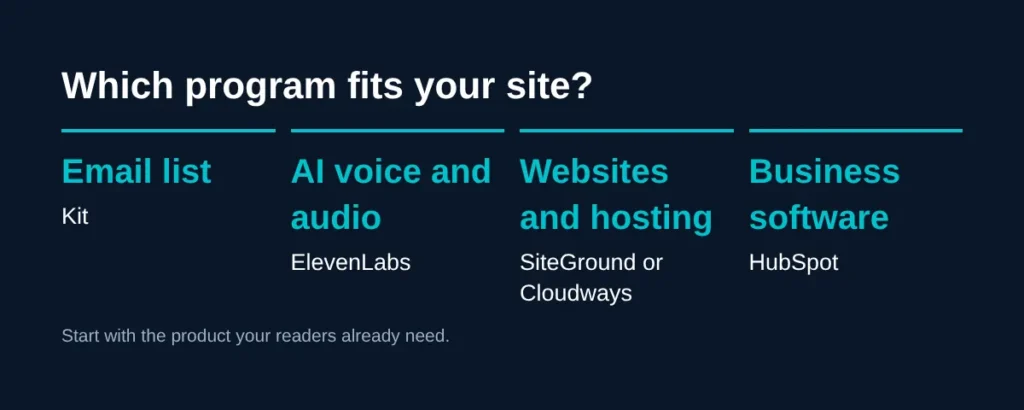
If you only want the short version, here it is. Pick the program that matches what your readers already need, and start with one or two.
- Building an email list or first funnel: Systeme.io has a free plan, and Kit pays a monthly commission for up to 12 months.
- Writing about AI voice and audio tools: ElevenLabs pays up to 22% for the first 12 months of a paid plan.
- Writing about websites and hosting: SiteGround and Cloudways pay per sale, and both publish tiered rates.
- Writing for business owners: HubSpot pays a recurring commission with a long cookie window.
- No niche yet: start with the program you have used yourself, because honest experience is what makes readers click.
Start free with Systeme.io → Free plan available, no card needed to look around. Check the current limits on the official site.
How to Judge an Affiliate Program Before You Join
Most beginners compare one number, the commission. That is the least useful number on the page. A program that pays $100 once but only remembers your link for a day can earn less than one that pays $20 a month and remembers your link for three months. Use these five checks instead.
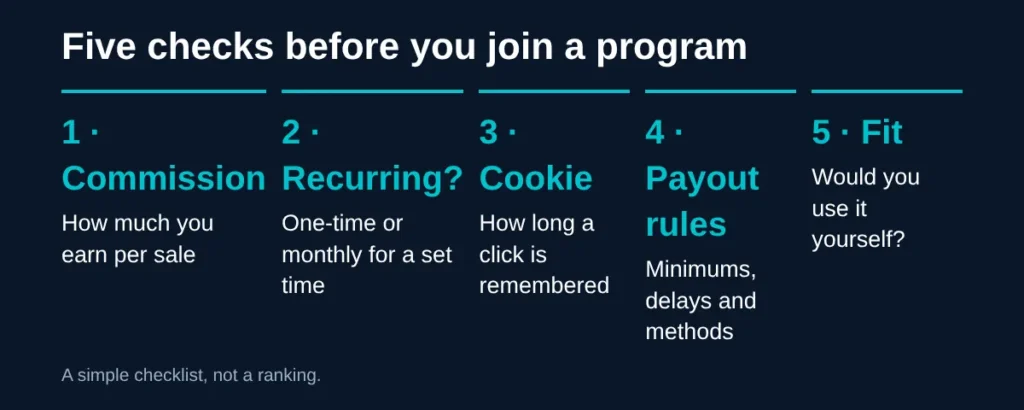
1. Commission: what you earn per sale
Commissions come as a percentage of the sale, a fixed amount per sale, or a mix. Percentages look generous on cheap plans and small on expensive ones, so ask what a typical customer pays. A fixed amount is easier to predict, but it rarely grows with the customer.
2. Recurring or one-time
Recurring commissions pay you again each month while the customer stays subscribed. They are slower to build and more valuable over time. Many “recurring” programs stop after a set period, often 12 months, so read how long it lasts before you count on it.
3. Cookie window
The cookie is the program’s memory of your referral. If a reader clicks your link today and buys in six weeks, a 30-day cookie pays you nothing, while a 90-day cookie does. Software people often compare for weeks, so longer is better for the tools in this guide.
4. Payout rules
Look for the minimum balance, the waiting period before a sale counts, and the payment method. These differ more than commissions do. One program pays weekly with no minimum, another needs hundreds of dollars before PayPal pays out, and both can be right for different people.
5. Fit: would you use it yourself?
This is the check beginners skip. Readers can tell when you have not touched a product. If you would not recommend it to a friend, it will not convert for strangers either. Fit also protects you: promote a product you understand, and your review writes itself.
How Affiliate Money Actually Works
If you are new to the idea, read our complete beginner’s guide to affiliate marketing first. In short, a company gives you a tracked link, a visitor uses it, and you are paid when they buy. The part that surprises beginners is the delay between the sale and the payout.
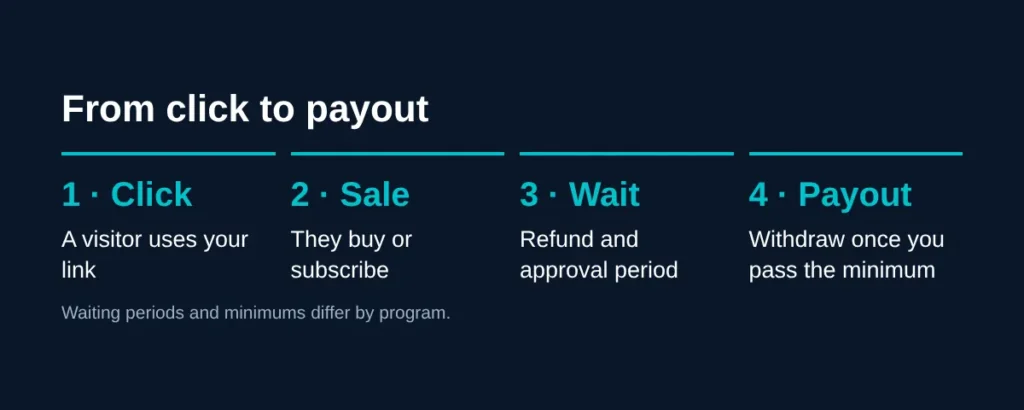
Almost every program holds commissions for a while so it can cover refunds. Kit, for example, says commissions are generated 31 days after a sale to cover the refund period. Cloudways only approves a signup commission after the customer upgrades from the trial and pays at least two full invoices. Plan for money to arrive weeks after the sale, not days.
One-time vs recurring: a simple illustration
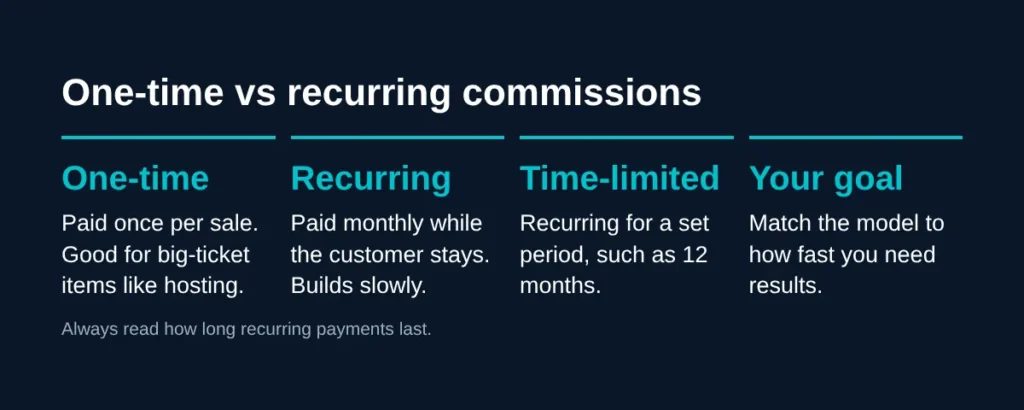
An illustration, not a promise: suppose a customer pays $20 a month and the program gives you 50% for 12 months. That would be $10 a month, or $120 from that one customer over the year, if they stay. Ten such customers would be about $1,200 over the year. Real results depend on traffic, trust and how many readers convert, and many beginners earn nothing for the first months. Treat any income figure you read online, including this one, as arithmetic and not as a forecast.
How to Read Affiliate Terms: Two Real Examples
Terms pages are written to protect the program, not to be friendly. Here is how to read two of them, using only what their official pages say in November 2026.
Example 1: Kit, a recurring commission
Kit says it pays 50% monthly for up to 12 months. Read that as three separate facts. First, 50% is the share. Second, “monthly” means it repeats while the customer keeps paying. Third, “up to 12 months” is the limit. Then look for the delay: commissions are generated 31 days after a sale, an invoice is created at the start of the next month, and Kit reviews it until it locks. Funds usually appear in your PartnerStack wallet around the 13th. Put together, a customer who signs up early in a month does not turn into money in your wallet for roughly six weeks, and the first payment is only the first of up to twelve.
Example 2: Cloudways, a per-sale commission with conditions
Cloudways offers a slab model, a hybrid model and a two-tier model, and you can switch between them, with changes taking effect the following month. The headline “up to $125” needs context: slabs depend on how many customers you bring that month, and they reset on the 1st. The fine print matters more than the headline. A signup counts only after the customer upgrades from the trial, authorizes billing and pays at least two full invoices, and trial referrals earn nothing. Payout then depends on the method: PayPal at $250 in approved monthly earnings, wire at $1,000, or a $100 minimum to move earnings into your Cloudways balance.
What these examples teach
- The headline number is the start of the story. Always read the conditions around it.
- Timing is part of the price. A commission that arrives in six to ten weeks is worth less to a beginner who is counting on it.
- Pages can disagree with themselves. Cloudways shows $100 and $150 on banners next to an “up to $125” headline. When numbers conflict, trust the live terms and write to support if it matters.
- Write down what you checked and when. Terms change, and a dated note lets you update your page honestly.
Affiliate Program Comparison: Verified Terms
This table shows the five programs whose terms we read on the official pages in November 2026. “Not stated” means the page we read did not give that number, not that the program has none.
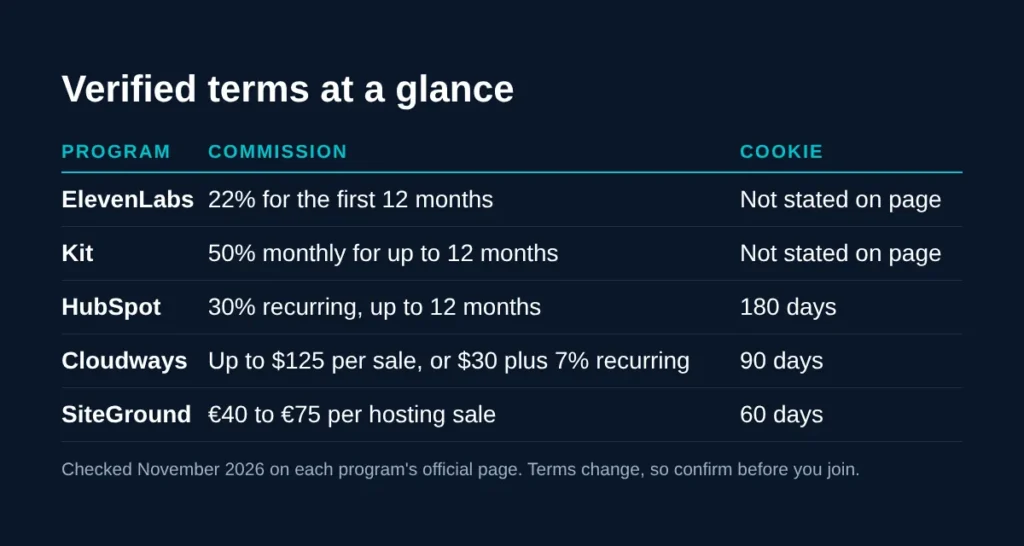
| Program | Commission | Cookie | Payout notes | Best for |
|---|---|---|---|---|
| ElevenLabs | Up to 22% for 12 months | Not stated | Through PartnerStack dashboard | AI voice creators |
| Kit | 50% monthly for up to 12 months | Not stated | $5 minimum; direct deposit, PayPal or Stripe by location | Creators with email lists |
| HubSpot | 30% recurring for up to 12 months | 180 days | $10 minimum; EFT or PayPal | Business and marketing audiences |
| Cloudways | Up to $125 per sale, or $30 plus 7% recurring | 90 days | PayPal at $250 monthly; wire at $1,000 | Hosting and WordPress readers |
| SiteGround | €40 to €75 per hosting sale | 60 days | Weekly, no minimum | Beginner website builders |
Sources: official pages for ElevenLabs, Kit, HubSpot, Cloudways and SiteGround, read November 2026. Programs change their terms, so confirm on the page before you join.
See SiteGround hosting plans → A fit if your readers are building their first website. Check current prices on the official site.
Affiliate Programs by Type of Site
Programs work best when they match what your readers are already trying to do. Here is how the 12 programs below fall into five groups.
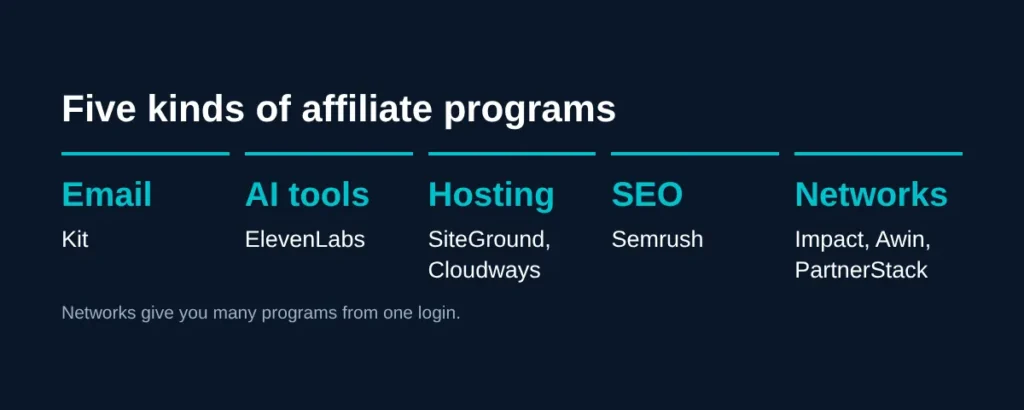
The 12 Best Affiliate Programs for Beginners
Each entry follows the same template: what it is, the terms, who it suits, and our verdict. Where we could not read the official terms, we say so and leave out the numbers.
1. Systeme.io: best for email, funnels and courses on a small budget
Systeme.io is an all-in-one platform with funnels, email, courses and blogs. It matters twice for an affiliate publisher: you can use it to build your own email list, and you can promote it through its own affiliate program.
Terms (program terms, April 2026): 60% recurring commission on every sale, for as long as the referral stays subscribed. Referrals are tagged to you permanently, not for a short cookie window. Anyone can join for free with no application. Payouts are monthly by PayPal or wire transfer, with a $30 minimum. Systeme.io says it has paid over $5,000,000 in commissions to affiliates. Confirm the current payout minimum and schedule in your affiliate dashboard.
Who it suits: beginners who want to learn email and funnels cheaply. There is a free plan, so you can try the product before you recommend it. Our Systeme.io review, pricing guide and ClickFunnels comparison cover it in detail.
Verdict: a strong first choice because you can use the product yourself and write from real experience.
Want every term in detail? Read our Systeme.io affiliate program review, including what we could not verify.
2. ElevenLabs: best for AI voice and audio content
ElevenLabs makes AI voice, speech and audio tools, and it runs its affiliate program through PartnerStack.
Terms (official page, November 2026): up to 22% commission on payments from new paid subscribers, for the first 12 months of each subscription. The PartnerStack listing shows a lower 11% rate on business-tier transactions. The page we read did not state a cookie length or a payout schedule, so check the program terms for those.
Who it suits: creators, podcasters and video makers who already write about voice tools. Start with our ElevenLabs review, the ElevenLabs vs Murf AI comparison and the roundup of the best AI voice generators.
Verdict: a good fit if AI audio is your topic. Skip it if it is not, because the product only sells to readers who need it.
3. Kit: best for creators who already have an audience
Kit (formerly ConvertKit) is an email marketing tool built for creators.
Terms (Kit help center, November 2026): 50% monthly commission for up to 12 months per referred customer. Qualifying affiliates with certain status levels can earn 10% to 20% recurring on referrals that stay past 12 months. The minimum to withdraw is $5. Commissions are generated 31 days after a sale to cover the refund period, then paid through your PartnerStack wallet by direct deposit, PayPal or Stripe, depending on where you live. The article we read did not state a cookie length.
Who it suits: bloggers and creators who write about email, newsletters and audience building.
Verdict: the 50% rate is the headline, but the value comes from the monthly recurring payments. You need an audience that cares about email.
4. HubSpot: best for business and marketing audiences
HubSpot sells a customer relationship management platform with marketing, sales and service tools.
Terms (official page, November 2026): 30% recurring commission for up to 12 months on each referred sale, a 180-day cookie window, and payouts by direct deposit (EFT) or PayPal once your balance reaches $10. Higher tiers have additional bonuses or custom rates, subject to approval.
Who it suits: writers whose readers run small businesses or marketing teams. The 180-day cookie is the longest in our verified set, which helps with a product people take months to evaluate.
Verdict: good for reviews and how-to guides aimed at business owners. Less natural for hobby sites.
Try ElevenLabs and hear the voices → Get a feel for the product before you write about it. Check current plan limits on the official site.
5. Cloudways: best for hosting readers who want performance
Cloudways is managed cloud hosting, popular with WordPress users who outgrow basic shared hosting.
Terms (official page, November 2026): three options. A slab model pays up to $125 per sale depending on how many customers you refer in a month. A hybrid model pays $30 per sale plus 7% lifetime recurring. A two-tier option pays 7% of what your referred sub-affiliates earn. The cookie lasts 90 days. PayPal payouts start once approved monthly earnings reach $250, wire transfers need $1,000 in approved commission, and you can instead add earnings to your Cloudways balance from $100. A signup commission is approved only after the customer upgrades from trial, authorizes billing and pays at least two full invoices.
A caution: the page’s banners show $100 and $150 per sale, which does not match the “up to $125” headline. Read the live terms before you promise anything to yourself.
Verdict: strong rates, but the approval rules mean sales take a while to count. Better for readers who are serious about hosting than for beginners.
6. SiteGround: best for first-time website builders
SiteGround is a beginner-friendly host that many people choose for their first WordPress site.
Terms (official page, November 2026): for hosting sales per month, €40 per sale for 1 to 5 sales, €60 for 6 to 10, and up to €75 for 11 to 20, with custom terms above that. The cookie lasts 60 days. Payouts are weekly with no minimum balance. Referrals that buy the Website Builder, an AI tool or an email product earn 60% of SiteGround’s first-year revenue from that sale if they qualify, but the page words this inconsistently, so check the terms.
Verdict: the weekly payouts with no minimum are friendly to beginners, who often wait a long time for their first payment elsewhere.
7. ThriveCart: best for sellers who want a one-time-payment checkout
ThriveCart is a checkout and sales-page platform. It also lets sellers run their own affiliate programs, setting commission by percentage or fixed amount, with separate rates for upsells and subscriptions.
Terms: we did not read ThriveCart’s own affiliate terms for this guide, so confirm commission, cookie and payout details on the official page. What the help documents do say is that sellers using ThriveCart choose first-click or last-click attribution and set the cookie length per link.
Verdict: useful if you plan to sell your own product later. For a first program, it is a second step.
8. TubeBuddy: best for YouTube creators
TubeBuddy is a browser extension that helps YouTube creators with keywords, tags and channel management.
Terms: we did not verify TubeBuddy’s current commission or cookie on its official page, so we leave the numbers out. Confirm them before you promote it.
Verdict: an easy sell if your audience is creators. A poor fit if no one on your site makes videos.
9. Semrush: best for SEO and marketing readers
Semrush is a well-known suite for keyword research, site audits and competitor analysis. It runs an affiliate program through an affiliate network.
Terms: not verified for this guide. Several third-party sites list per-sale and per-trial payments, but we could not open Semrush’s own page, so we do not repeat their figures.
Verdict: a natural match for SEO content. The product is complex, so you need to understand it before you review it.
10. ClickFunnels: best for funnel-focused marketers
ClickFunnels is a funnel-first platform. It is the usual comparison point for Systeme.io, and we cover the trade-offs in our Systeme.io vs ClickFunnels guide.
Terms: not verified for this guide. Third-party sources describe a recurring commission, but check the official affiliate page for the current percentage, cookie and payout schedule.
Verdict: worth considering if your readers are funnel builders and you can explain why they would pay more than for an all-in-one tool.
11. Amazon Associates: best for easy product recommendations
Amazon Associates lets you earn a commission on physical products people buy after clicking your link. Rates vary by product category, and the tracking window is short compared with software programs.
Terms: we did not read Amazon’s own page for this guide. Amazon sets rules about eligibility and how you may use links, so read the operating agreement.
Verdict: easy to start and trusted by readers, but rates are low and the short window means you earn mostly on impulse buys. Good for gear lists, less so for software.
12. PartnerStack: best for finding software programs in one place
PartnerStack is a network, not a single product. ElevenLabs and Kit both pay their affiliates through it, which means one account and one wallet can cover more than one program. Other networks worth knowing are Impact and Awin, which list many brands.
Terms: each brand sets its own commission and cookie, so there is no single set of numbers. Payout rules also depend on the brand and your region.
Verdict: a practical way to find and manage several programs without separate logins, once you know your niche.
Side-by-Side: Which Program Fits Which Goal
| Your goal | Start with | Why |
|---|---|---|
| Build an email list on a small budget | Systeme.io | Free plan to learn on, and you can review what you use |
| Write about AI voice tools | ElevenLabs | Clear niche match and a 12-month commission window |
| Earn monthly from creators | Kit | 50% monthly for up to 12 months |
| Teach people to build websites | SiteGround | Weekly payouts with no minimum |
| Serve business owners | HubSpot | Longest verified cookie at 180 days |
| Review hosting seriously | Cloudways | Several commission models, but slower approval |
| Not sure yet | One product you already use | Experience makes reviews believable |
How to Choose Between Two Good Programs
Sometimes two programs both fit your readers. Hosting is the classic case: SiteGround and Cloudways both suit people building websites. Here is a simple way to decide without overthinking it.
Start with the reader, not the rate
Ask which product you would actually point your reader to. SiteGround is a beginner-friendly host for a first WordPress site. Cloudways is managed cloud hosting for people who already know they want more control. A beginner who lands on a review of the advanced option may leave, even if the commission looks better. Match the product to the reader’s stage first.
Then compare how the money arrives
Use the verified table above. SiteGround pays weekly with no minimum, which suits a site with few sales. Cloudways has higher possible payments per sale, but needs a customer to pay two full invoices and a larger balance before PayPal pays out. If you expect a handful of sales in your first months, the program that pays sooner may matter more than the one that pays most.
Consider recurring over one-time only when the audience stays
Recurring programs such as Kit and HubSpot reward products people keep using. If your readers tend to try a tool for a month and move on, a recurring commission may never reach its full length. If they build businesses on the tool, it may. Think about how long a typical reader would actually stay.
It is fine to promote both
There is no rule that you must pick one. A fair comparison page can recommend each for the right reader, and readers tend to trust a page that says “choose this if you are a beginner, choose that if you want more control”. We did exactly that in our ElevenLabs vs Murf AI comparison. The key is honesty: say plainly which one you would pick and why.
Oscar’s Picks: Where to Start
- Best first program: Systeme.io, because you can use it for free and learn from it.
- Best for recurring income: Kit, based on its published 50% for up to 12 months, if your audience cares about email.
- Best with no traffic yet: SiteGround, because weekly payouts with no minimum mean your first sale is not stuck behind a threshold.
- Best for business readers: HubSpot, for the 180-day cookie and recurring structure.
These are judgments from the published terms, not results from our own testing of each program’s payouts. Your results will depend on your traffic and how well each product fits your readers.
A Simple Path for Your First 90 Days
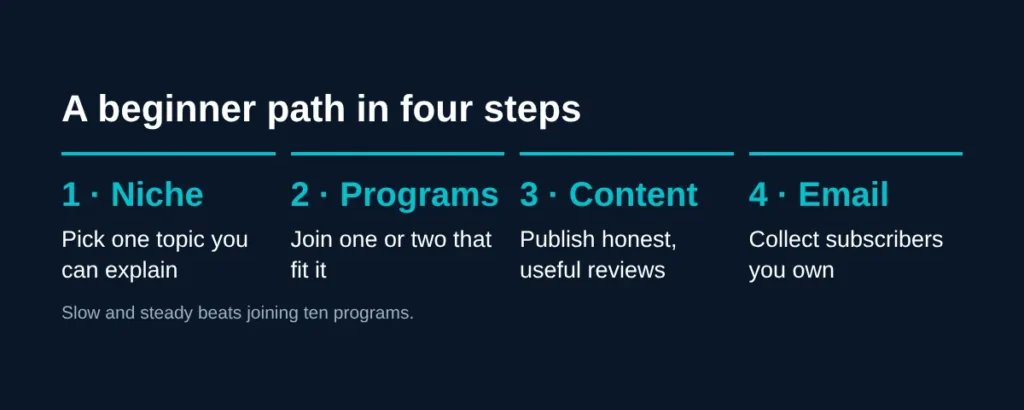
You do not need ten programs. You need one topic and a few helpful pages. This order works for most beginners.
- Pick one niche you can explain. A narrow topic is easier to rank for than “affiliate marketing” in general.
- Join one or two programs that fit it. Use the matrix above.
- Publish honest, useful pages. A review, a comparison and a how-to are enough to start. Show limits as well as strengths.
- Collect email subscribers. Search traffic can drop. An email list is yours. Our free beginner checklist is a simple way to start one.
Want the full picture of how the pieces fit together? Our Start Here page lays out the path, and the Top Programs page collects the programs we cover.
No website yet? Follow our step-by-step guide to building an affiliate website on WordPress. When your site has real content, you can also read how to get Google AdSense approved if you want to add ads alongside affiliate links.
Common Beginner Mistakes
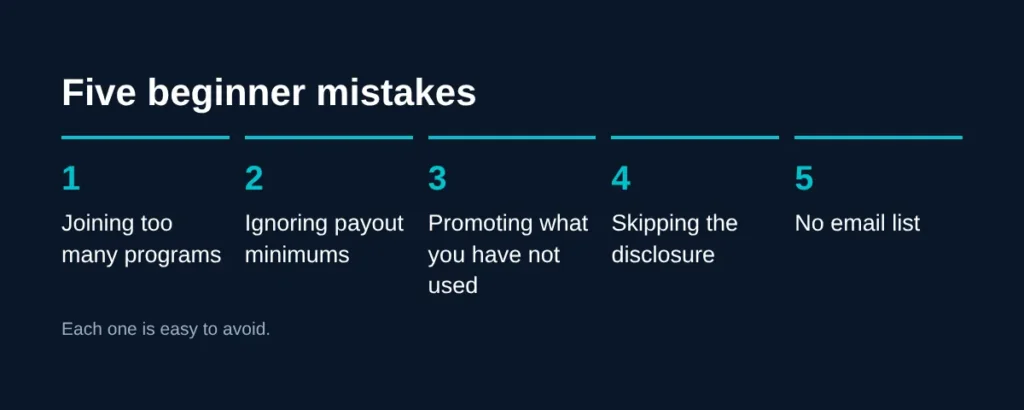
- Joining too many programs. Each has its own rules, dashboard and links. Learn one before adding another.
- Ignoring payout minimums. A $250 threshold can sit between you and your first payment for a long time.
- Promoting what you have not used. Readers can tell, and so can the people who read the reviews against yours.
- Skipping the disclosure. Tell readers when a link earns you a commission. It is the honest thing to do, and many places require it.
- Having no email list. If your only source of readers is search, one update can wipe out your traffic.
Our Honest Recommendation
Choose one program that matches what your readers already need, learn how it pays, and write one genuinely useful page about it. Commissions look big on a comparison table, but they only matter once you have readers who trust you.
If you have the time, join the program for a product you already use. If you do not use any yet, start with a free tool such as Systeme.io and learn by building something. Then add a second program only when the first is working.
Try Systeme.io free and build your first list → Learn by doing, in less time than it takes to read another comparison. Free plan available; check the current limits on the official site.

Get the Free Beginner Checklist
Not ready to choose yet? Our free checklist walks you through picking a niche, choosing a first program and publishing your first helpful page. Get the free checklist →
Best Affiliate Programs for Beginners: FAQ
What is the best affiliate program for a complete beginner?
The best one is the program for a product you have used and can explain. For many beginners that means a tool with a free plan, such as Systeme.io, because you can learn the product before you recommend it.
Do I need a website to join an affiliate program?
Many programs ask where you will promote their product, and some want a site or an established social account. Requirements differ, so read each program’s terms. A simple site with a few helpful pages gives you the most options.
Are recurring commissions better than one-time commissions?
Not always. Recurring commissions build over time, but many stop after about 12 months. One-time commissions pay sooner. Match the type to your patience and your readers’ buying habits.
How long does it take to get paid?
Weeks, usually. Programs hold commissions to cover refunds, and many need a minimum balance. Kit generates commissions 31 days after a sale, and Cloudways approves a signup only after two paid invoices. SiteGround says it pays weekly with no minimum.
How much can a beginner earn from affiliate marketing?
It varies widely, and many beginners earn little or nothing in the first months while they build content and trust. We do not promise an amount. Earnings depend on your traffic, the match between product and reader, and how long you keep publishing.
Questions to Ask Before You Apply to Any Program
Applying takes a few minutes, but unwinding a bad choice takes weeks of rewriting. Before you click “join”, answer these questions in plain words. If you cannot answer one, that is a signal to read the terms again.
- Who is the reader, and what are they trying to do? “People who want to start a newsletter” is a reader. “Everyone online” is not.
- Have I used the product, or will I before I write about it? A free plan or trial makes this easy. If there is no way to try it, be honest in your review about what you have and have not tested.
- How long does the program pay? Forever, 12 months, or once? Write the answer next to the program name.
- How long does the link last? If the cookie length is not on the page, ask the program or treat it as unknown.
- What is the minimum payout, and how long is the waiting period? Add them up. A sale in January may only reach your bank in March.
- Are there rules about how I may promote it? Some programs limit paid ads on their brand name, coupon sites or email use. Read the terms once, fully.
- What happens if the program changes its terms? Programs can lower rates or close. That is one more reason not to depend on a single program.
Disclose your links and track what happens
In the United States, the Federal Trade Commission expects you to clearly tell readers when you earn from a link, and other countries have similar rules. Put a short disclosure near the top of every page, as we do here, and keep it in plain language. It also helps with trust, which is what makes readers click in the first place. Our affiliate disclosure page explains how AffiliateCrownd earns money.
Then keep a simple record. For each program, note the date you joined, the commission model, the cookie length if known, the minimum payout and where your links appear on your site. Once a month, check each program’s dashboard and ask two questions: which pages sent the clicks, and which clicks turned into sales. After a few months you will see which reviews earn and which only get read. That is the information that tells you what to write next, and it is far more useful than any list of the highest commissions.
Conclusion
The best affiliate programs for beginners are the ones that fit your readers, pay in a way you can plan around, and sell a product you understand. Use the five checks, pick one or two programs from this list, and confirm the current terms on each official page before you join.
Next, read our beginner’s guide to affiliate marketing if you want the basics, or our Systeme.io review if you want a free tool to practice on.
How We Checked This Guide
In November 2026 we read the official affiliate pages or help articles for ElevenLabs, Kit, HubSpot, Cloudways and SiteGround and took the figures from them. The Systeme.io figures come from the terms published in its affiliate program, dated April 2026. For ThriveCart, TubeBuddy, Semrush, ClickFunnels, Amazon Associates and PartnerStack we could not read the official terms, so we describe the programs without numbers. We did not test these programs’ payouts ourselves. Terms change, so we will update this guide as we verify more of them.