
Affiliate Marketing With No Money: A Step-by-Step Guide for Beginners (2026)
By Oscar · 16 min read
Disclosure: some links in this guide are affiliate links, including links to Systeme.io, ShortPixel and Cloudways. If you sign up or buy through them, AffiliateCrownd may earn a commission at no extra cost to you. Other tools are linked plainly. It never changes our advice. Read our affiliate disclosure and how we research.
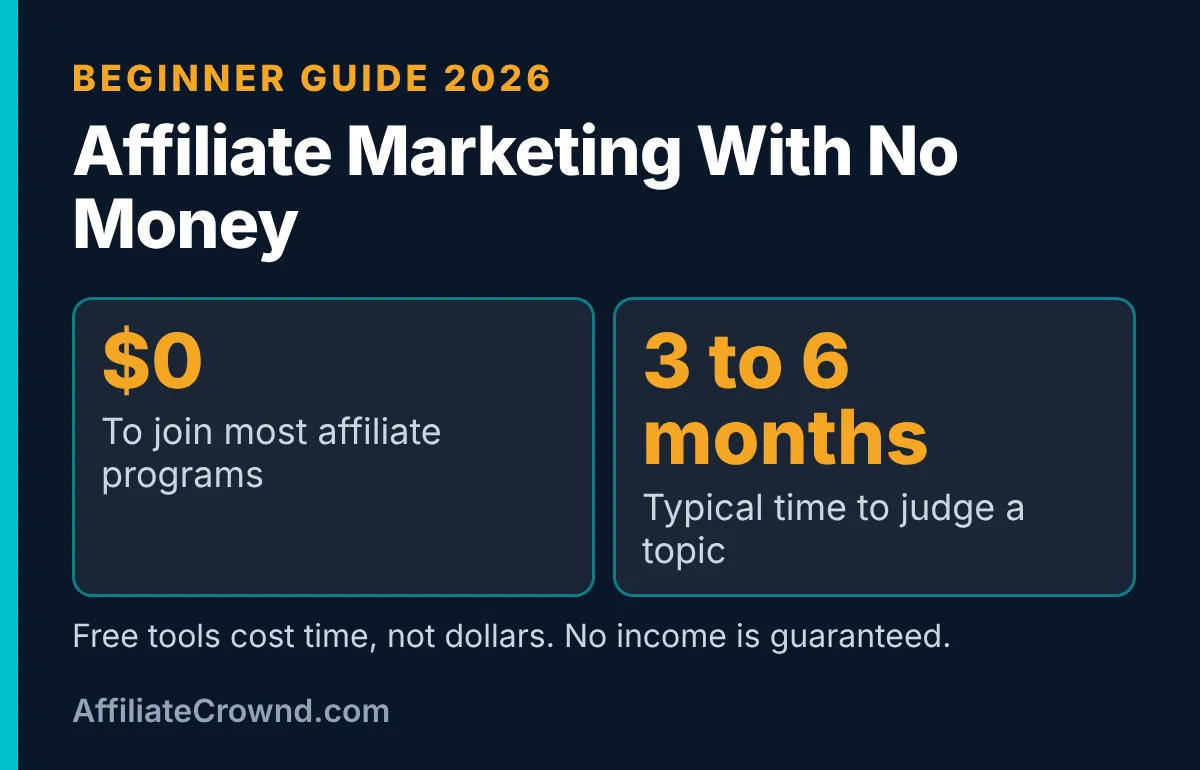
Affiliate marketing with no money is possible, but it is not magic. You can start without paying for ads, a course or a fancy website, because several of the tools you need have free plans. What you cannot skip is time: you pay with hours of learning, writing and patience instead of dollars. This guide shows the exact path, what is truly free, what is worth paying for later, and the mistakes that waste months.
Nothing here is a promise of income. Most beginners earn nothing for a while, and some never earn much. The honest goal of this guide is to help you start the right way, at no cost, so that if it works you have built something real, and if it does not, you have lost nothing but time.
Quick Answer: Can You Start Affiliate Marketing With No Money?
Yes. You need four things, and all four have a free version:
- A place to publish. A free blog, a free website builder plan, a social profile or a newsletter.
- An affiliate program that accepts beginners. Many programs are free to join.
- Useful content. Articles, videos or posts that help one specific type of person.
- A way to be found. Search engines and social platforms send free visitors, but slowly.
The catch: free tools have limits, and free traffic takes months. Plan on three to six months of steady work before you can judge whether a topic works. Paid tools and a custom domain are a sensible upgrade after you see signs of life, not before.
Last reviewed: November 11, 2026. Tools change their free plans often, so confirm the details on each company’s own page before you sign up.
Table of Contents
What “No Money” Really Means in Affiliate Marketing
Before the steps of affiliate marketing with no money, it helps to be exact about what is free and what is not, because many guides blur the line.
Free: joining most affiliate programs, creating accounts on free platforms, writing content, using free search tools, learning from free guides, and building an email list on a free plan.
Costs money later (optional): a custom domain name, hosting that you control, paid email automation, keyword tools with larger data, and paid ads.
Costs time always: research, writing, publishing, learning what your readers want, and waiting for search engines to trust a new site.
If you treat time as the real price, the plan becomes easy to judge. A beginner who spends ten focused hours a week for six months has invested about 250 hours. That is a real investment, even with a zero-dollar budget, so choose a topic you can stay interested in.
The Four Questions Every Beginner Asks
People who search for this topic usually want one of four answers. This guide covers all four so you do not have to open ten tabs.
- What is affiliate marketing, and how does a free start work? (learn the basics)
- Which free options are best, and how do they compare? (compare your choices)
- Where do I sign up, and what do I do first? (take action)
- Where are the official pages for the tools mentioned? (find the right sites)
If you are brand new to the idea, read our plain-language guide to what affiliate marketing is first, then come back.
Step 1: Pick a Topic for Affiliate Marketing With No Money
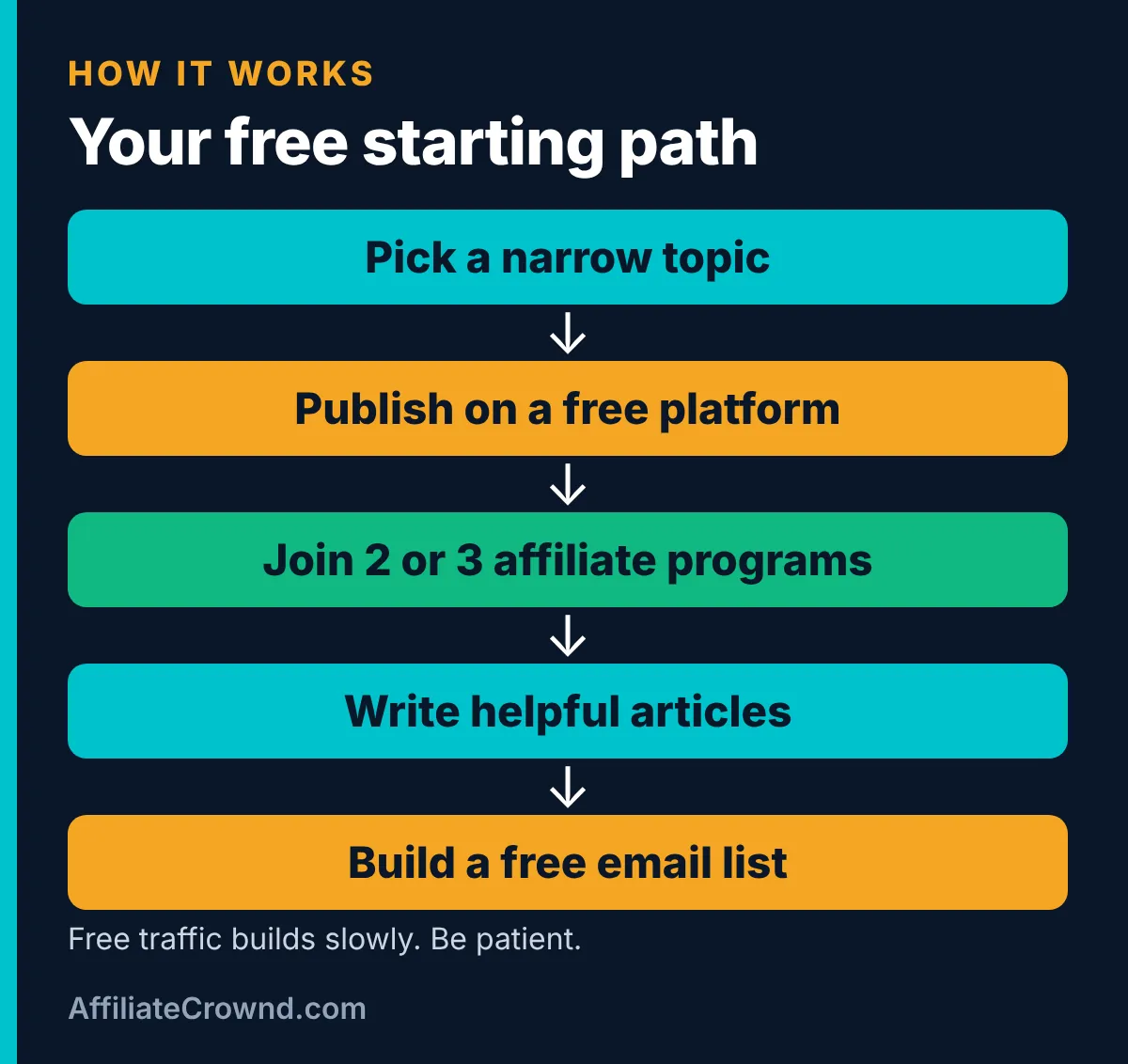
The biggest free advantage you have in affiliate marketing with no money is focus. A narrow topic is easier to rank for than a broad one, and it is easier to write about honestly.
Good beginner topics share three traits:
- You have some knowledge or real curiosity. You do not need to be an expert, but you must be willing to learn and test.
- People spend money on it. There are products, software or services people buy to solve the problem.
- It has related questions. You can write at least twenty different articles about it.
Weak topics are too broad (“health”), too crowded for a new site (“best VPN”), or too narrow to ever write more than three articles.
A simple test: write down ten questions a beginner in that topic would ask. If you can answer five of them honestly, you have enough to start.
Step 2: Choose Where You Will Publish for Free
You have a few free places to publish affiliate marketing with no money content. Each has trade-offs, and you can combine them.
| Option | Cost | Good for | Main limit |
|---|---|---|---|
| Free blog or website plan | $0 (paid upgrade available) | Search traffic over time | Platform branding, fewer features, you do not fully own the address |
| YouTube channel | $0 | Reviews and how-to videos | Needs filming, editing and patience for the algorithm |
| Newsletter on a free email plan | $0 up to the plan’s limit | Building an audience you own | Needs a way to collect subscribers |
| Social profile (Pinterest, short video, others) | $0 | Reaching people fast | Platform rules can change, and not all allow affiliate links |
| Podcast | $0 to $ low | Interviews and storytelling | Slow to grow, harder to link to products |
Our suggestion for most beginners: start with a blog, because written content is the easiest to rank, update and expand. Add an email list early, because it gives you an audience that no platform can take away.
If you want the full process for building a site, follow our guide to building an affiliate website on WordPress.
Is a Free Blog Good Enough to Start?
For learning, yes. For long-term ranking, a site on your own domain is better, because you control the address, the design and the future. The good news is that you do not have to decide on day one. Start free, publish your first ten to fifteen articles, and move to your own domain when you see the first search visitors. Moving a young site is much easier than moving a large one.
One caution: check the platform’s rules before you add affiliate links. Some free plans limit outside links or ads, so read the terms first.
Step 3: Join Your First Affiliate Programs (Free)
Most affiliate programs you need for affiliate marketing with no money are free to join. You apply, they review your site or channel, and you receive a tracking link.
What to look for in a program:
- Commission and type. Is it a one-time payment, or recurring? Recurring pays you again each month while a customer stays.
- Cookie length. How long after a click will a sale still count for you?
- Payout terms. Minimum payout, payment method and schedule.
- Beginner friendliness. Some programs approve new sites quickly, others want existing traffic.
- A product you would honestly recommend. If you would not use it yourself, skip it.
Our guide to the best affiliate programs for beginners compares twelve programs on these points.
Examples of Programs Worth Checking
These examples are not promises of approval or earnings. Terms change, so always read each program’s own page.
| Program type | Example | Why beginners look at it |
|---|---|---|
| All-in-one funnel platform | Systeme.io | Has a free plan and an affiliate program, see our affiliate program review |
| Email marketing for creators | Kit | Free plan up to 10,000 subscribers, and its own affiliate program |
| WordPress image tool | ShortPixel | Free tier, plus an affiliate program for site owners |
| Managed cloud hosting | Cloudways | Popular with site owners who outgrow shared hosting |
When you apply, be honest about your plans. Describe the topic, the content you will publish and how you will disclose your links. Programs approve honest, clear applications more often than vague ones.
Where Do You Apply?
Most programs run through their own “affiliate” or “partners” page, or through a network such as PartnerStack or similar. Search for the company name plus “affiliate program,” and use the official result. Be careful with copycat pages: a real program never asks you to pay to join.
Step 4: Learn the Four Search Intents (This Is Free and Powerful)
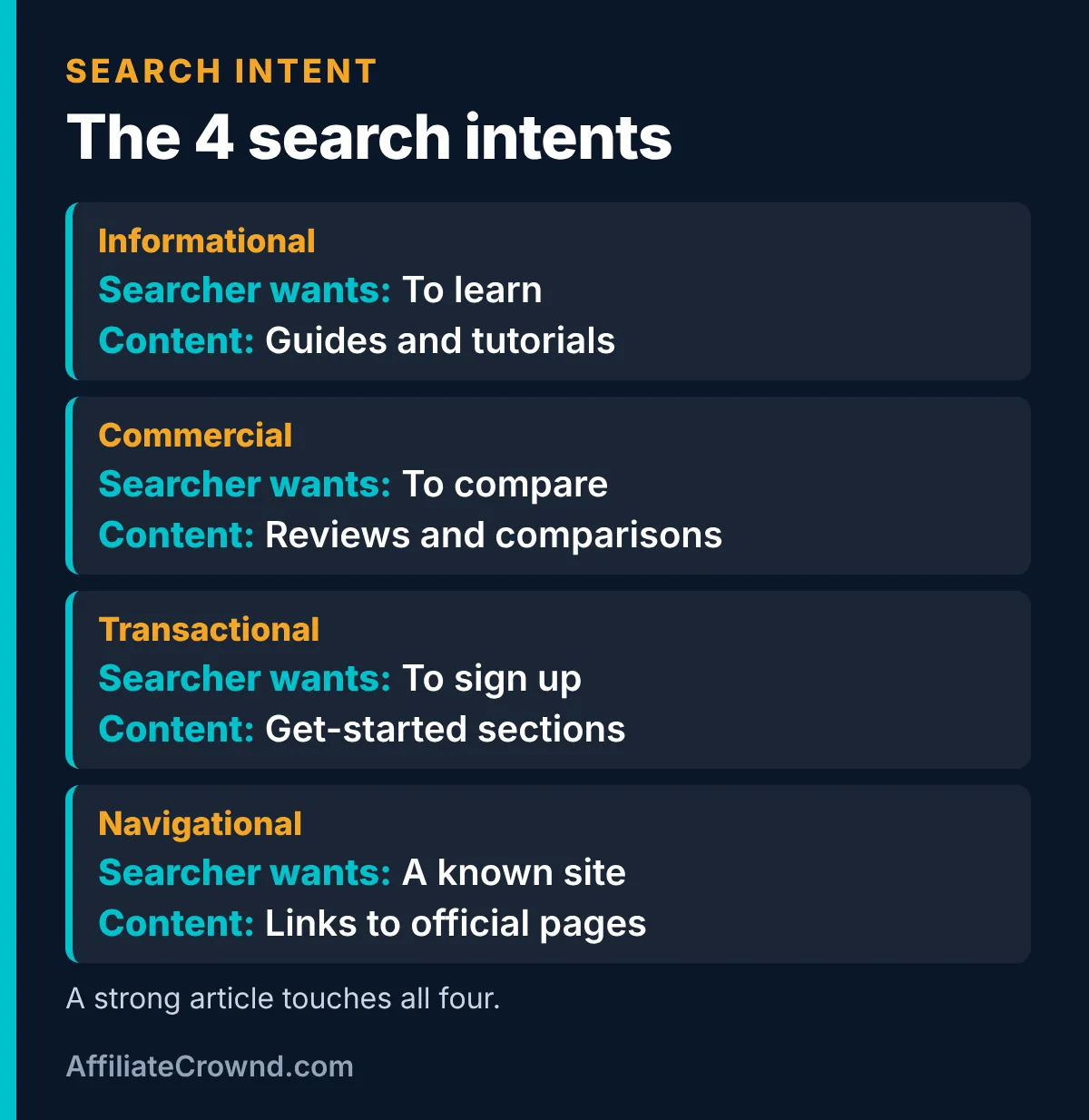
Search intent is the reason behind a search, and matching it matters in affiliate marketing with no money. Matching it is one of the cheapest ways to rank, because it costs nothing but thought.
| Intent | What the searcher wants | Example search | Content that fits |
|---|---|---|---|
| Informational | To learn | “what is affiliate marketing” | Guides, explainers, tutorials |
| Commercial investigation | To compare before buying | “kit vs mailerlite” | Reviews, comparisons, best-of lists |
| Transactional | To buy or sign up | “kit free plan sign up” | Pricing pages, get-started sections |
| Navigational | To reach a known site | “kit pricing page” | Clear links to official pages |
A strong beginner article touches all four. It teaches the topic, compares options, shows how to start, and links to the official pages. That is why every guide on this site ends with a “get started” section.
Once you are comfortable with the basics, our search intent guide goes deeper with more examples.
Step 5: Write Your First Helpful Articles
In affiliate marketing with no money, content is where free effort turns into assets. Start with a small set of articles that answer real questions.
A simple starting set (ten articles):
- A beginner guide to your topic.
- Three “how to” tutorials that solve small problems.
- Two comparisons between tools or methods.
- Two honest reviews of products you have actually tested or researched carefully.
- One “mistakes to avoid” article.
- One list of free tools for your topic.
How to write each article so it can rank:
- Put the main phrase in the title, the first paragraph and at least two headings.
- Answer the question quickly at the top, then explain.
- Use short paragraphs, lists and tables so it is easy to read on a phone.
- Include a get-started section so readers can act.
- Add images with clear alt text that describes the picture.
- Link to your own related articles and to official sources.
- Disclose affiliate links near the top.
For an example of how we structure an honest review, see our Systeme.io review: what we checked, what we did not test, and who the tool fits.
Can You Write Without Real Experience?
You can write honestly without claiming experience you do not have. Say what you researched, what the official pages show, and what you have not tested. Readers and search engines both reward transparency. Never invent tests, screenshots or income results.
Step 6: Use Free Tools to Rank and Track
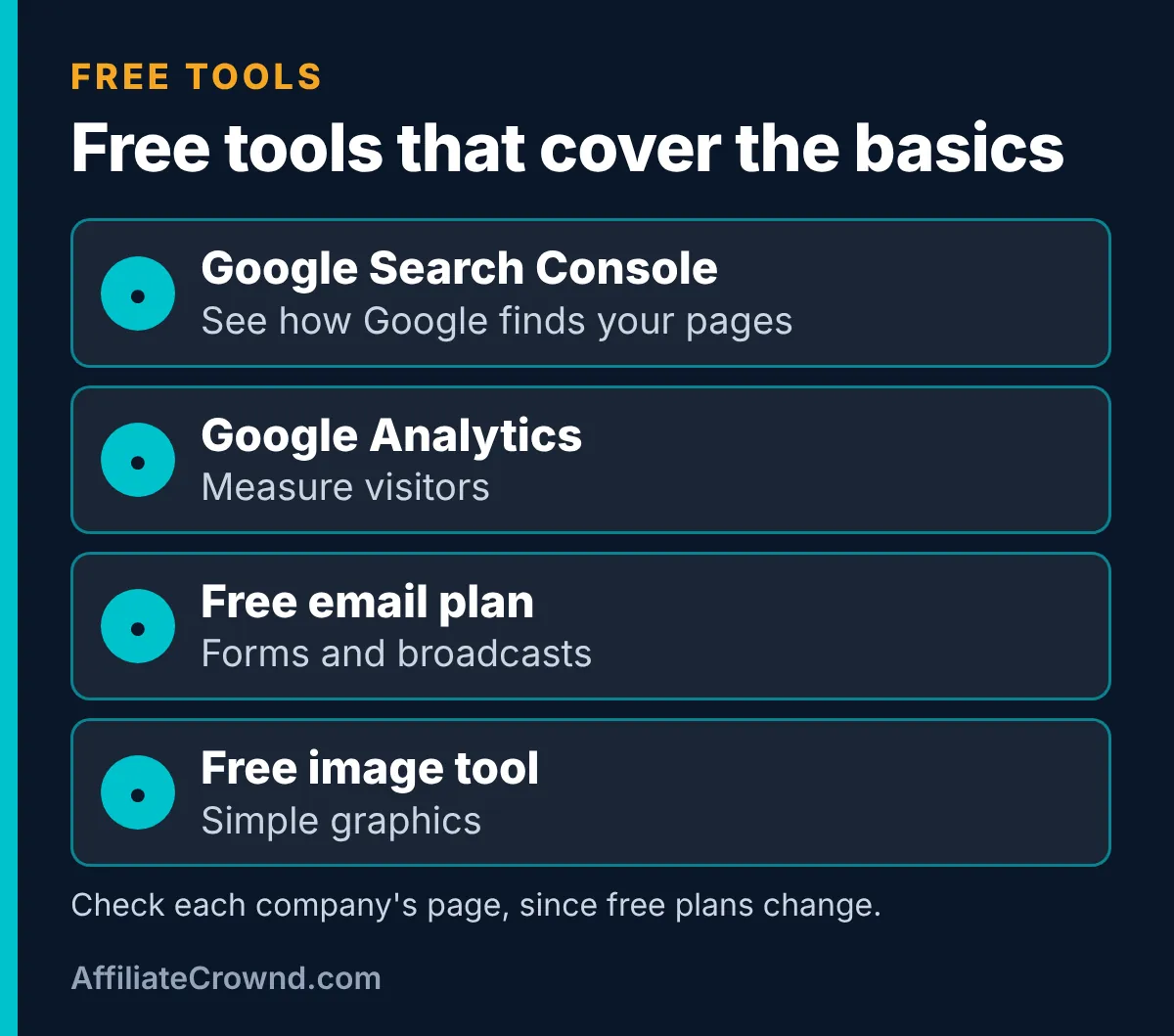
You do not need paid software to start affiliate marketing with no money. These free options cover most of what a beginner needs:
| Need | Free option | What it does |
|---|---|---|
| See how you appear in Google | Google Search Console | Shows search queries, clicks and indexing problems |
| Measure visitors | Google Analytics | Shows traffic and behavior |
| Find ideas | Google’s search suggestions and “People also ask” | Shows questions real people type |
| Create images | Canva free plan or a screenshot tool | Makes simple graphics |
| Collect emails | Kit free plan or the Systeme.io free plan | Forms, landing pages and broadcasts |
| Compress images | A free compressor such as the ShortPixel free tier | Keeps pages fast |
Start with these, and add a paid tool only when a free one becomes the thing holding you back.
Set up Search Console on day one. It is free, and it tells you whether Google can see your pages at all.
Step 7: Build an Email List From the Start
An email list is the best free asset in affiliate marketing with no money, because you own it. Search traffic can rise and fall. A subscriber who trusts you can hear from you whenever you publish something new.
A simple free setup:
- Create a free account with an email tool that has a free plan.
- Make one small free resource, such as a checklist.
- Add a signup form at the end of your best articles.
- Send a short welcome email with your three most helpful articles.
- Send a regular update, even if it is short.
Compare tools before you pick one. Kit’s free plan and our free plan guide for Systeme.io show two different approaches, and our email list guide gives the step-by-step process that works with any tool.
Step 8: Get Free Traffic (Slowly)
Free traffic for affiliate marketing with no money comes from four main places, and it all takes patience.
- Search engines. The best long-term source. New sites often wait several months before they see steady visits.
- Pinterest and visual search. Good for visual topics such as home, food, crafts and planning.
- YouTube. Good for demonstrations and comparisons, and videos can keep ranking for years.
- Communities. Forums and groups where you answer questions honestly. Read the rules, never spam, and disclose your links.
Do not buy followers, fake reviews or bulk backlinks. They can get your site penalized and your affiliate accounts closed.
Start with search plus one other channel you enjoy, and give each at least three months before you judge it.
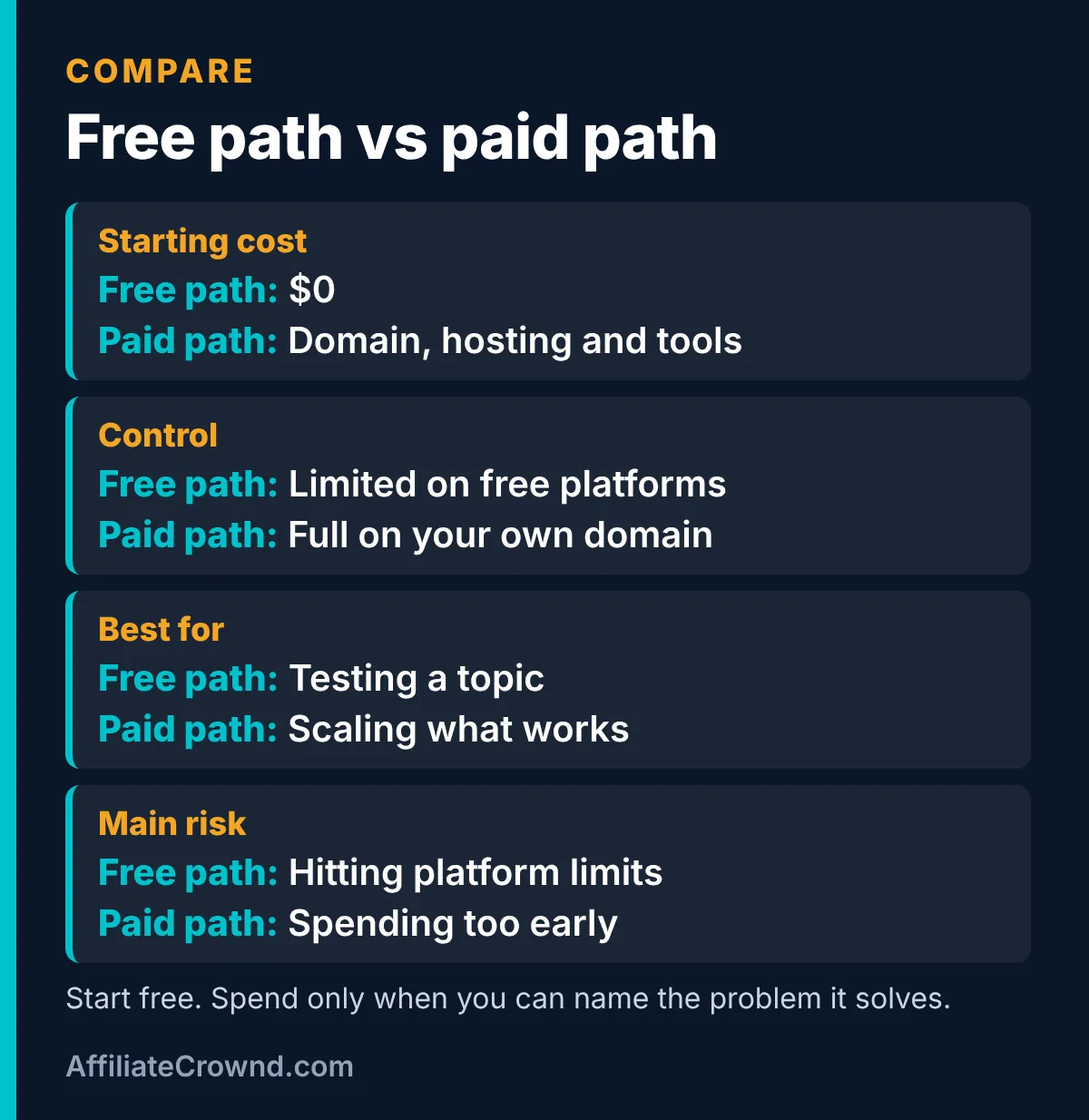
Free Path vs Paid Path in Affiliate Marketing With No Money
This table shows the real trade-off in affiliate marketing with no money, so you can decide when to spend.
| Free path | Paid path | |
|---|---|---|
| Starting cost | $0 | A domain, hosting and tools, often a few hundred dollars over the first year |
| Speed to first publish | Same day | Same day or a few days |
| Control over your site | Limited on free platforms | Full control on your own domain and hosting |
| Look and features | Basic | More themes, plugins and options |
| Traffic | Slow, organic | Can add paid ads, which carry risk |
| Best for | Testing a topic and learning | Scaling once something works |
| Main risk | Hitting platform limits | Spending before you know what works |
Our recommendation: start on the free path, learn what your readers respond to, and spend only after you have evidence. A common first purchase is a domain name, followed by hosting. If you reach that stage, our hosting guides compare the options with real renewal prices.
When Is It Worth Spending Money?
Spending on affiliate marketing with no money makes sense only when it removes a clear bottleneck.
| Bottleneck | Possible fix | When to do it |
|---|---|---|
| Your site address looks unprofessional | Buy a domain | After 10 to 15 good articles |
| The free platform limits your growth | Move to your own hosting | After you see steady search visits |
| You send emails by hand | Upgrade email automation | When a welcome sequence would save real time |
| You cannot find keywords | A keyword tool | After you have exhausted free methods |
| You publish too slowly | Hire help for editing or images | After your process is proven |
Spend small, one thing at a time, and write down what you expect it to do. If it does not help in two or three months, stop paying.
Common Mistakes in Affiliate Marketing With No Money
- Choosing a topic only because it pays well. If you lose interest in a month, the money never arrives.
- Joining twenty programs on day one. Start with two or three that fit your topic.
- Writing thin articles. A short, shallow post rarely ranks. Make each article truly useful.
- Copying other sites. Search engines penalize duplicate content, and readers notice.
- Hiding affiliate links. Always disclose, near the top of the page, as the FTC’s disclosure guidance explains.
- Expecting fast results. Most new sites take months to gain traction.
- Ignoring email. Without a list, every visitor who leaves is gone.
- Falling for “free money” schemes. Real programs do not charge to join and do not promise guaranteed income.
- Quitting after ten posts. Many beginners stop right before the first results.
- Skipping the basics of trust. An About page, a contact page and honest reviews matter.
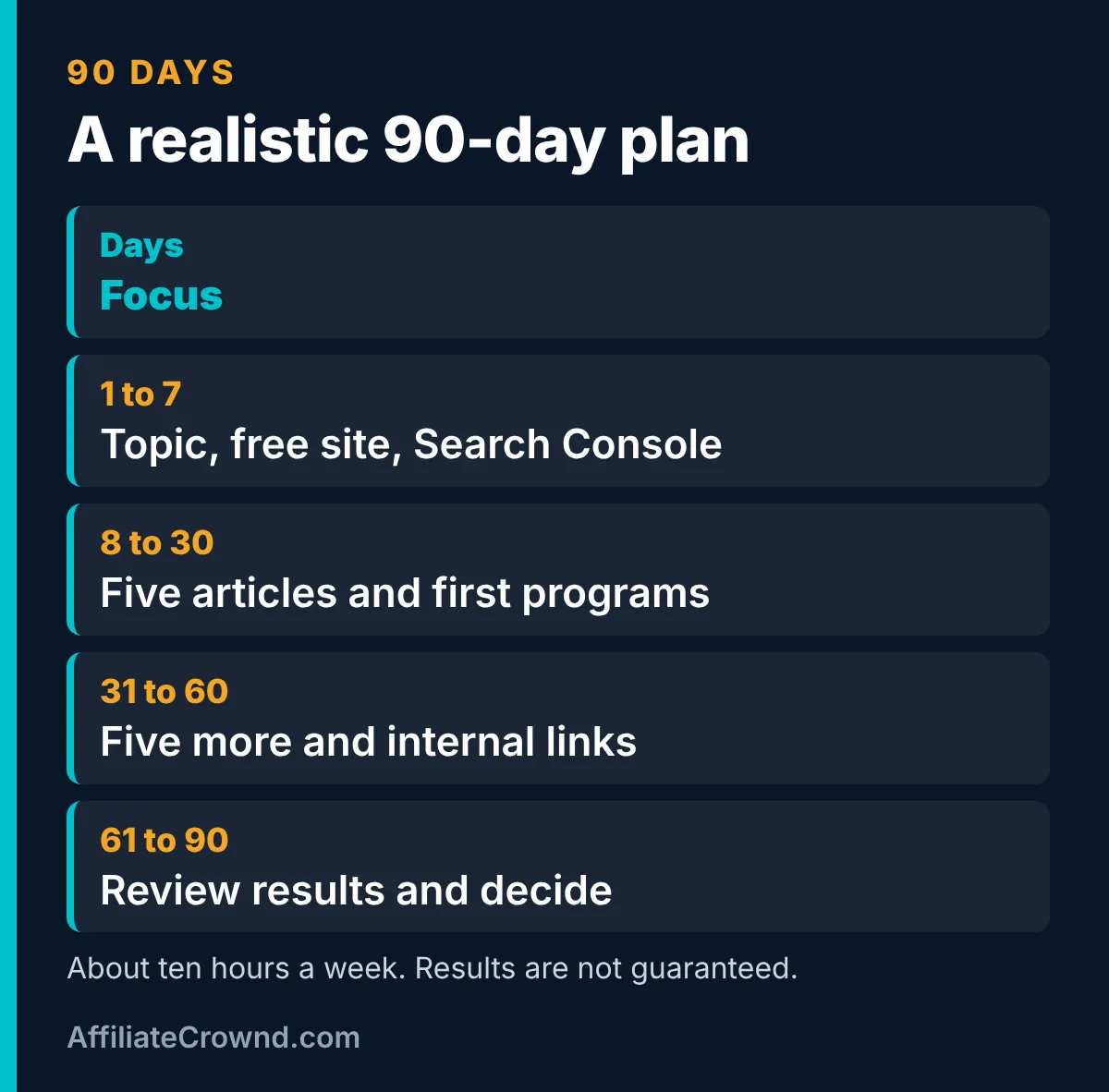
A Realistic 90-Day Plan for Affiliate Marketing With No Money
Here is a simple schedule for affiliate marketing with no money that you can adapt. It assumes about ten hours a week.
Days 1 to 7: Foundation
- Pick your topic and write ten questions.
- Create your free site or channel and your free email account.
- Set up Search Console and an About page.
Days 8 to 30: First content
- Publish your first five articles, including one beginner guide.
- Apply to two or three affiliate programs.
- Add a signup form and a simple free resource.
Days 31 to 60: Build and improve
- Publish five more articles and add internal links between them.
- Check Search Console for any indexing problems.
- Write your welcome email.
Days 61 to 90: Review and decide
- Look at which articles get impressions and which get clicks.
- Improve the best ones with more detail and images.
- Decide whether to buy a domain, based on your results and interest.
At day 90, you will know much more than any guide can tell you. Keep what is working, drop what is not, and continue for another 90 days.
How to Get Started Right Now
Starting affiliate marketing with no money takes less than an hour. Follow these steps in order.
- Write down your topic and ten reader questions. This keeps you focused.
- Open a free account on the platform you chose. A blog, a channel or a newsletter all work.
- Create a free email account with an email tool. Compare Kit and Systeme.io before you pick.
- Set up Google Search Console. It takes about ten minutes.
- Apply to one affiliate program that fits your topic. Start with our beginner program list.
- Draft your first article. Use the writing tips above.
- Publish, then share it with one person. Their feedback is worth more than your first visitor count.
Our Honest Recommendation
If you want to try affiliate marketing with no money and you have no budget, start with a simple blog and a free email list, on a topic you can explain in your own words. Join two or three programs that you would honestly recommend, publish helpful articles consistently, and be patient. Spend money only when you can name the exact problem it solves.
If your plan depends on fast income, this is the wrong path. Affiliate marketing with no money is a slow, steady craft, closer to building a small publication than to a quick trick. If you enjoy helping people choose well and you can stay consistent, it is one of the few online businesses you can begin without cash.
If you would rather see how a full site is built, our WordPress setup guide shows the steps in detail.
Frequently Asked Questions
Can I really start affiliate marketing with no money?
Yes. Many programs are free to join, and platforms for publishing and email have free plans. You will spend time instead of money, and free traffic usually takes months to build.
What is the best free way to start affiliate marketing?
For most beginners, a blog plus a free email list is the best start, because written content can rank in search for years and an email list is an audience you own. YouTube is a good alternative if you enjoy video.
How long does it take to make the first sale?
It varies widely. Some people get a first sale within weeks from an existing audience, while a brand-new site can take several months. Nobody can promise a date, and results depend on your topic, content and consistency.
Do I need a website to do affiliate marketing?
Not always. You can use YouTube, social profiles or a newsletter, but each platform has rules about affiliate links. A website gives you the most control, which is why we suggest one as the long-term base.
Do affiliate programs charge to join?
Legitimate programs do not. If a company asks you to pay to become an affiliate or promises guaranteed income, treat it as a warning sign and look for another program.
Conclusion
Starting affiliate marketing with no money is realistic if you accept the real cost, which is time. Pick a topic you can help with, publish on a free platform, join a few honest programs, write useful articles that match what searchers want, and build an email list from day one. Spend money only when it solves a clear problem.
Take the first small step into affiliate marketing with no money today: write your ten reader questions. Then follow our email list guide, and when you are ready to collect emails, start on the Systeme.io free plan.
Sources and checking: program terms and tool plans change, so confirm each one on the company’s official page. Search Console and Analytics are Google products with free access. We update this guide when major details change.