
Affiliate Link Disclosure: How to Disclose Affiliate Links Properly (2026)
By Oscar · 16 min read
A reader clicks your link, buys the tool and you earn a commission. Nothing is wrong with that. The problem starts when the reader does not know you earn money from the click. An affiliate link disclosure is a short, plain notice that tells readers you may be paid if they buy through your links. This guide explains what the FTC and Google say about it, where to put the notice, which words work and which do not, how to mark your links, and how to check every page. Everything below comes from official pages we read on November 10, 2026.
Disclosure: this guide contains no affiliate links, and nobody paid for it. It is general information, not legal advice, and it covers United States rules. Other countries have their own rules, so check the ones that apply to you. Read how we work in How We Research and Review.
Table of Contents
Quick Answer: How Do You Disclose Affiliate Links?
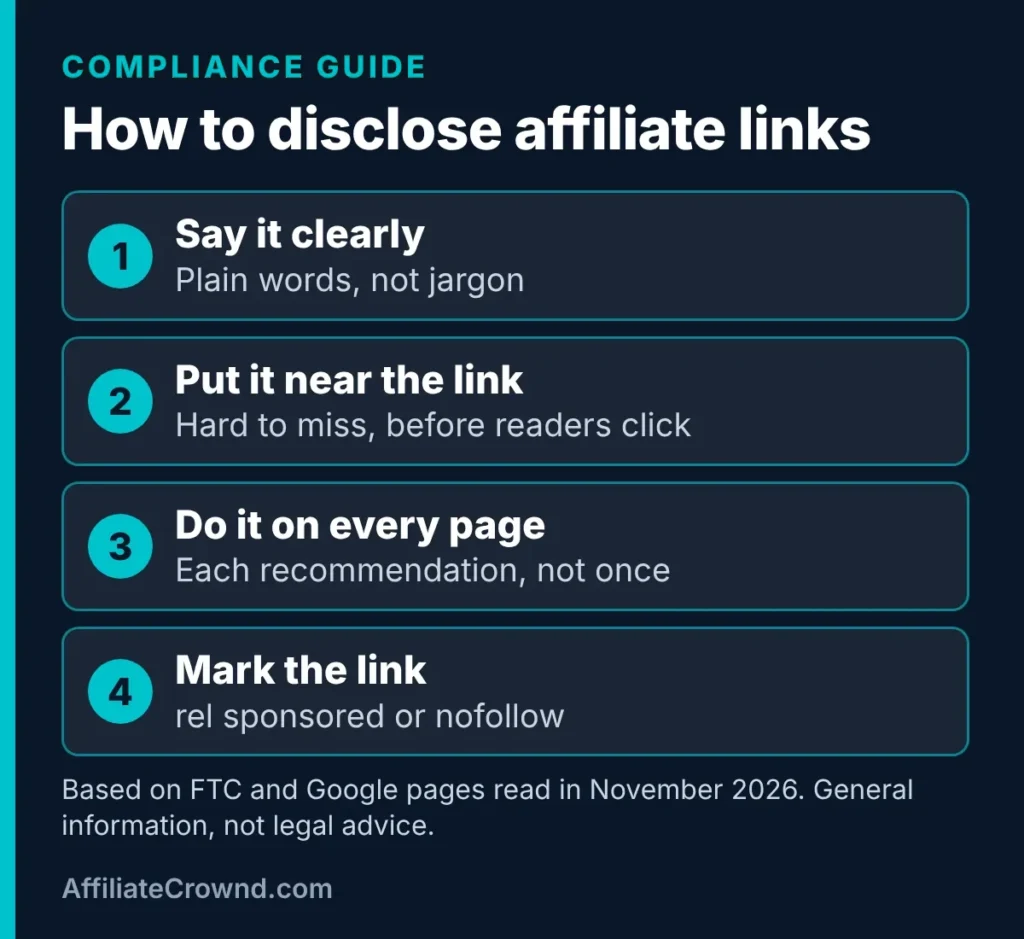
- Say that you earn a commission in plain words, such as the FTC’s own example: “I get commissions for purchases made through links in this post.”
- Put the notice near the link, where readers see it before they click. A notice only at the bottom or on a separate page is easy to miss.
- Repeat it on every page that has affiliate links, not once on your home page.
- Mark the link itself with
rel="sponsored"orrel="nofollow"so Google can tell it is a paid link.
Why Disclosing Affiliate Links Matters
There are three reasons, and the first one is simply honesty. Readers weigh a recommendation differently when they know the writer earns from it. Telling them lets them decide how much weight to give your opinion. Because we publish reviews and comparisons, we think it is the baseline of being trusted.
The second reason is the rule. The FTC says affiliate marketers should disclose their relationship with the retailer clearly and conspicuously so readers can weigh the endorsement. The FTC’s Endorsement Guides were revised in 2023, and the agency’s own question and answer page explains how they apply to affiliate links. Violating the principles in the Guides can lead to enforcement under Section 5 of the FTC Act, according to that page, although the Guides themselves do not have the force of law.
The third reason is search. Google does not ban affiliate links. It asks you to qualify paid links with an attribute, and it warns against thin affiliate pages that add nothing original. A clear disclosure and a useful, original page work together: the first shows honesty, the second shows value.
What Counts as a Material Connection?
The FTC uses the phrase “material connection” for a relationship that could affect how readers see your recommendation. In FTC’s Disclosures 101 for Social Media Influencers, the agency lists financial, employment, personal and family relationships. It also says the financial side is not limited to money: you should disclose the relationship if you got anything of value to mention a product.
| Situation | Disclose? | Why |
|---|---|---|
| You earn a commission when readers buy through your link | Yes | A financial relationship with the seller |
| A brand sends you a free product or a free account and you write about it | Yes | Something of value was given for the mention |
| A friend or family member owns the company | Yes | A personal or family relationship |
| You bought a product yourself with no relationship and you like it | No statement needed | The FTC page says you need not state that you have no relationship |
| You link to a tool with a plain link and earn nothing | No disclosure needed for that link | There is no connection to disclose, so do not label it as sponsored |
Two more points from the same FTC page are worth remembering. First, you should disclose even if you think your opinion is unbiased. Second, do not assume your readers already know about your brand relationships from other posts. A new visitor may land on one review and never see the rest of your site.
Where to Place the Disclosure
Placement is where many sites go wrong. The FTC says the closer the disclosure is to your recommendation, the better. The FTC Q&A page also says a disclosure at the bottom of a blog or page is easy to miss because many readers never reach the end, and that a single disclosure on a home page is not sufficient because visitors may read individual reviews without seeing it. A hyperlinked button labelled DISCLOSURE is called easily avoidable, since many people will not click it.
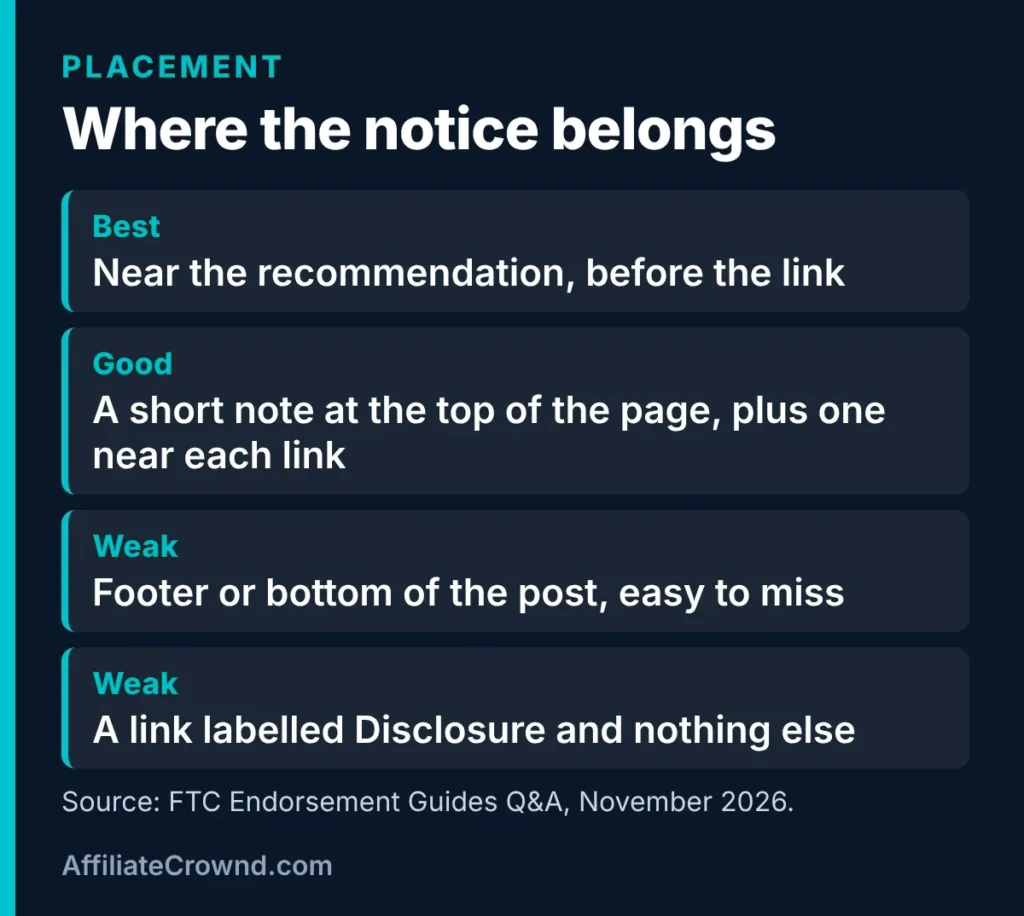
Putting those points together, here is how the common options compare. The ratings are our reading of the FTC guidance, not an FTC grade, and they are not a safe harbor.
| Placement | What the FTC pages suggest | Our verdict |
|---|---|---|
| Right beside or inside the recommendation | Closer to the endorsement is better, and one notice may be enough when the link sits in the review | Best |
| A short notice at the top of the page | Readers see it before any link, but it can be separated from a link far down the page | Good, add notices near links on long pages |
| A notice only at the bottom of the post | Easy to miss because many readers never reach the end | Weak |
| A footer link to a disclosure page | A hyperlinked disclosure is easily avoidable and a home page notice alone is not sufficient | Weak on its own, fine as an extra |
| A notice only in the comments | The FTC calls a disclosure in a comment thread easily avoidable | Not acceptable |
On this site we put a disclosure paragraph at the top of every article that contains affiliate links, mark each affiliate link as sponsored, and keep a full affiliate disclosure page as an extra. That page is a reference, not our only disclosure, because the FTC says a link to a separate page is easy to skip.
Wording: What to Say and What to Avoid
Use simple, clear language, in the same language as the recommendation. The FTC page for influencers gives examples such as “advertisement,” “ad” and “sponsored,” and it warns against vague terms such as “sp,” “spon” or “collab.” For affiliate links in particular, the Q&A page makes these points:
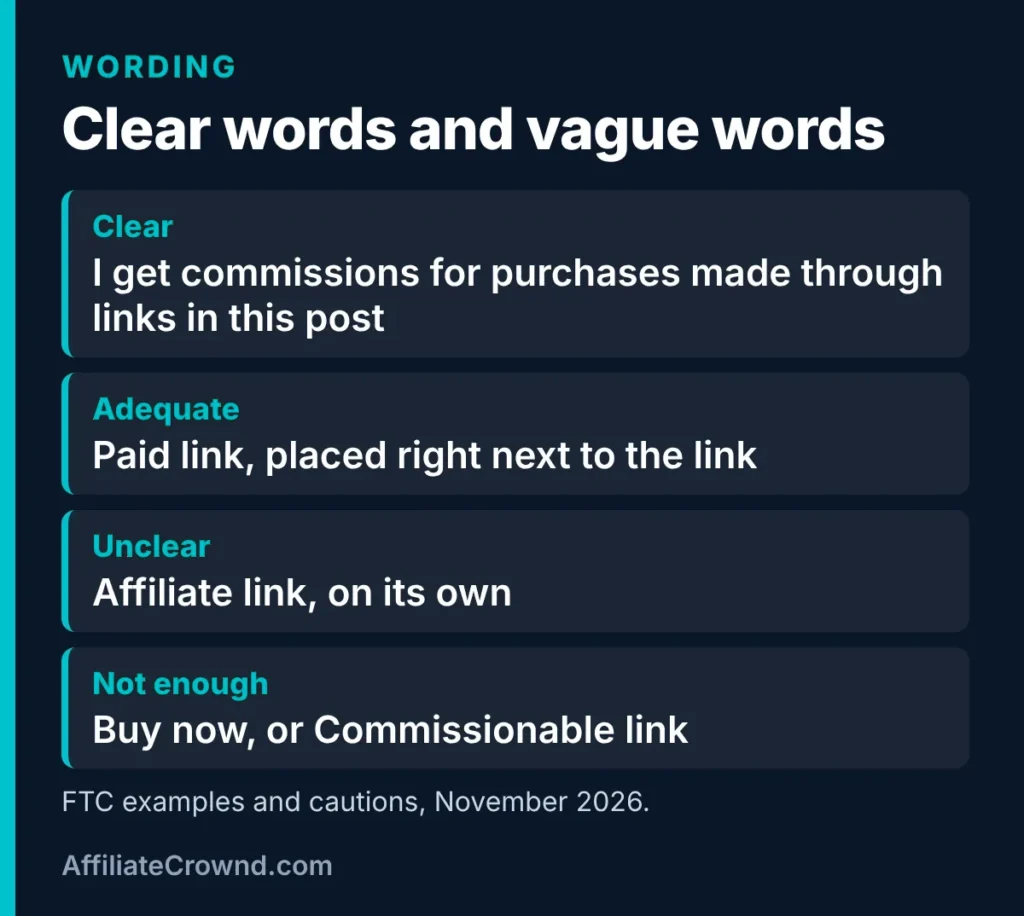
- “I get commissions for purchases made through links in this post” is the FTC’s own suggested wording.
- “Paid link,” placed right next to an affiliate link, is described as an adequate disclosure of the link’s nature.
- “Affiliate link” on its own may not be understood, because some consumers may not realize the person is paid for purchases.
- “Commissionable link” is probably not a clear disclosure, and a “buy now” button is not adequate.
The practical lesson is to say what happens in everyday words: you earn a commission if the reader buys. That sentence is short enough to put next to every button.
Disclosure examples you can adapt
These are example lines of our own, written in the spirit of the FTC wording. Adapt them to your voice, and keep the meaning.
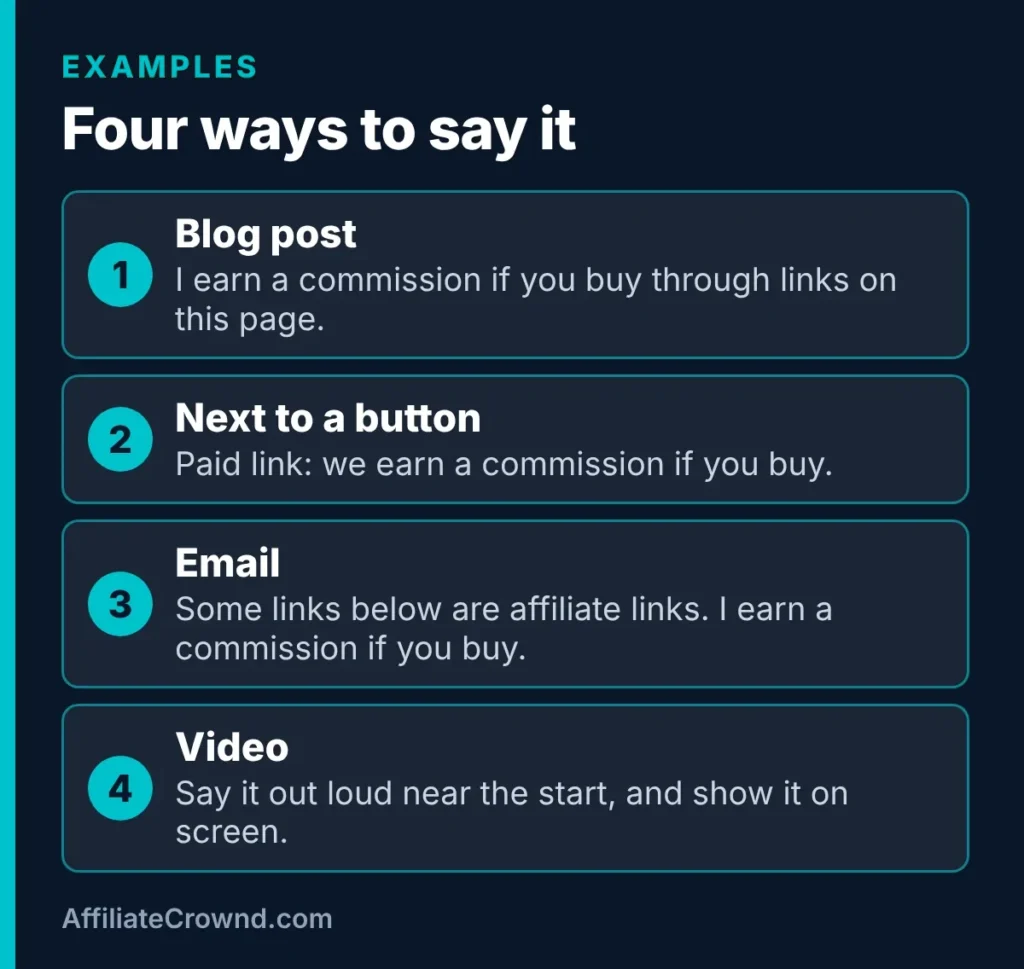
| Where | Example wording |
|---|---|
| Top of a blog post | I earn a commission if you buy through links on this page. |
| Right next to a button | Paid link: I earn a commission if you buy. |
| In an email | Some links in this email are affiliate links. I earn a commission if you buy through them. |
| In a video | Say it out loud near the start, and also show it on screen. The FTC says a disclosure only in the upload description can be missed. |
| A comparison table | A line under the table: Links in this table are affiliate links, and I earn a commission if you buy. |
One caution on the phrase “at no extra cost to you.” Many sites add it. Keep it only if it is true for the product you recommend, and never let it make the commission sound like it does not exist. The commission itself is the part that must be clear.
Marking the Link: rel Sponsored, Nofollow and Plain Links
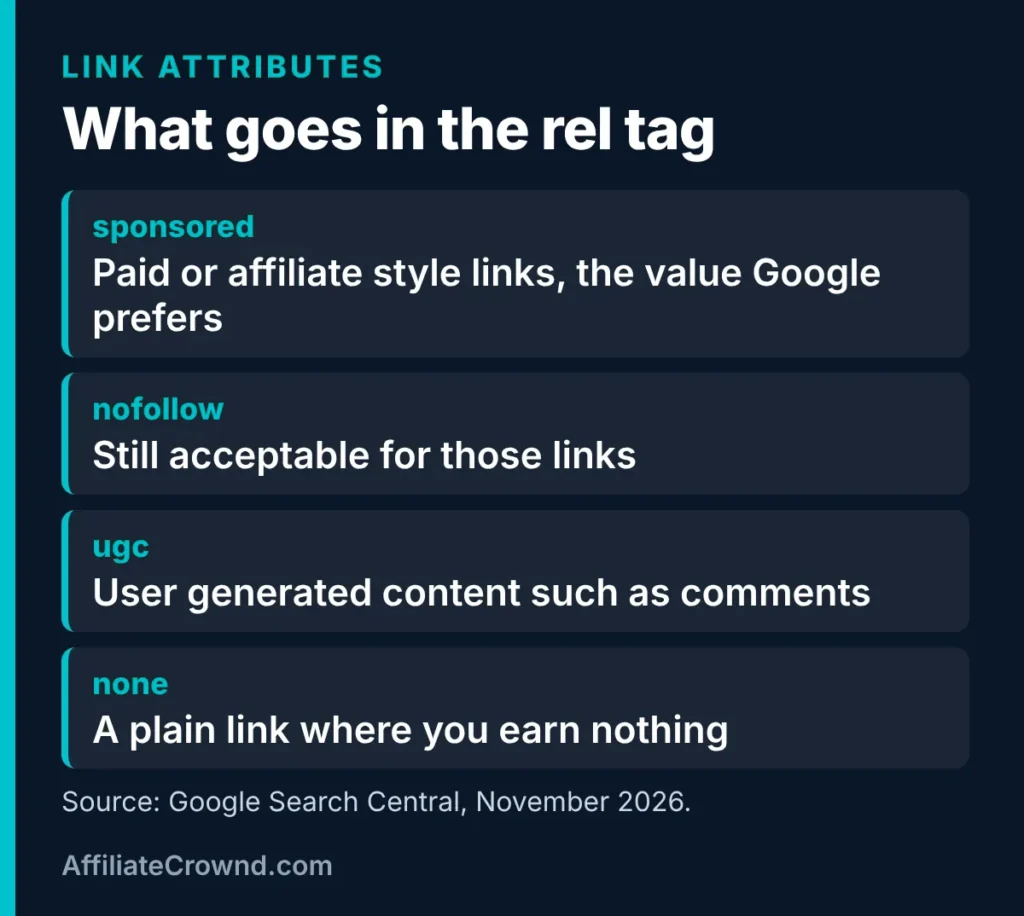
A disclosure for readers is one job. Marking the link for search engines is a second job. According to Google’s guidance on qualifying outbound links, Google prefers rel="sponsored" for links that are advertisements or paid placements, and says nofollow is still an acceptable way to flag them. The page does not name affiliate links specifically, so treating them as paid links is our inference, but it is how most publishers handle them. Google does not require any value, and it says you can combine values by separating them with a space, as in rel="nofollow sponsored", which is how our own affiliate links are set up.
| Attribute | Use it for | Notes |
|---|---|---|
| sponsored | Paid links, ads and affiliate style links | Google’s preferred value for paid placements |
| nofollow | Links you do not want to vouch for, or paid links | Google says it is still acceptable for paid links |
| ugc | Comments and forum posts by users | Not for your own affiliate links |
| No attribute | Normal links where you earn nothing | Do not mark these as sponsored |
Google also notes that marked links are generally not followed, but the pages may still be found through sitemaps or other sites. The attribute does not replace the disclosure. The two work side by side: one for people, one for search engines.
In the WordPress block editor, many people add the attribute through their link plugin’s settings, or by choosing “Edit as HTML” on a block and adding rel by hand. The exact settings depend on your plugin and editor version, so test one link and view the page source to confirm the attribute appears.
Disclosing a Program You Have Not Joined Yet
Often you will write about a tool without an affiliate link, then add one later. That is fine. While the link is plain, there is nothing to disclose and nothing to mark. The moment you swap in an affiliate link, three things change at once: the link gets its attribute, the page needs a notice near it, and any sentence that says “we do not earn from this” must go. We follow that routine on this site, and it is why a few of our reviews still use plain links to official pages.
Programs Have Their Own Rules Too
The FTC is not the only rulebook. Each affiliate program publishes its own terms, and they can be stricter than the law. For example, in the terms we read in November 2026, Descript’s program prohibits Google ads and unapproved discount codes, and WellSaid Labs asks affiliates not to use paid ads with their link. Always read the terms of each program you join, and keep a note of the date you read them.
This is also why our reviews list a program’s commission, tracking window and rules when we have verified them, and say “not stated” when we have not. For more detail on specific programs, see our guide to the best affiliate programs for beginners and our best AI voice generators article.
Disclosure and Google: Do They Affect Rankings?
A disclosure notice on its own is not a ranking factor that we can point to, and we will not claim otherwise. What Google does publish is a policy on spam. In Google’s spam policies, thin affiliation is described as publishing product affiliate links where the descriptions and reviews are copied from the merchant with no original content or added value. Good affiliate pages add value through original reviews, testing and ratings, comparisons or useful price information. The same page describes scaled content abuse as producing many pages mainly to manipulate rankings, however the content is made.
So the safest approach has two halves: be honest about the commission, and make the page worth reading without the links. Compare real plans, say what you did not test, and avoid income promises. We cover how we do that in our build an affiliate website on WordPress guide.
Affiliate Link Disclosure on Email, Social Media and Video
Your blog is not the only place where you share links. Many beginners add a careful notice to every article, then paste the same affiliate link into a newsletter, a social post or a video description with no notice at all. The rule does not change with the channel. If you earn from the click, the reader in that channel should know before they act.
Email newsletters
Put a short affiliate link disclosure in the email itself, close to the first paid link. A line in your signup form or on your website does not travel with the email, so subscribers who read on their phone never see it. A simple sentence works: “Some links in this email pay me a commission if you buy.” Keep it in the body, not hidden in the grey footer text.
Social media posts
The FTC page for influencers says to put the disclosure in the post itself, not only in your profile, and to make it visible without the reader having to click “more.” On a short post, that means the notice goes at the start, next to the link or product mention. Platform tools such as branded content labels can help, but they do not replace your own clear words.
Video and podcasts
If you recommend a product in a video, say the disclosure out loud as well as writing it in the description. Many viewers never open the description, and some watch with the sound off, so doing both covers more people. In a podcast, say it near the recommendation rather than only at the end of the episode.
- Email: one plain sentence near the first paid link.
- Social: the notice inside the post, visible before “more.”
- Video: say it on screen or out loud, and repeat it in the description.
- Every channel: the same honest meaning, in the same language as the recommendation.
The easy way to stay consistent is to write your affiliate link disclosure once for each channel and save it as a snippet. Then you paste it every time instead of rewriting it from memory, and nothing slips through on a busy day.
Common Affiliate Disclosure Mistakes
- One notice in the footer. Readers who never scroll to the bottom never see it.
- A link to a disclosure page and nothing else. The FTC calls a hyperlinked disclosure easily avoidable.
- Vague labels. “Affiliate link” alone, “commissionable link” or “sp” may not be understood.
- Marking everything as sponsored. A plain link where you earn nothing should stay plain.
- Forgetting email and video. The same rule applies wherever you recommend and earn.
- Letting terms go stale. If a program changes its rules or you leave it, update the page.
- Assuming readers already know. A visitor may read only one page of your site.
A Seven-Check Disclosure Audit
Use this list before you publish a page, and again when you refresh it.
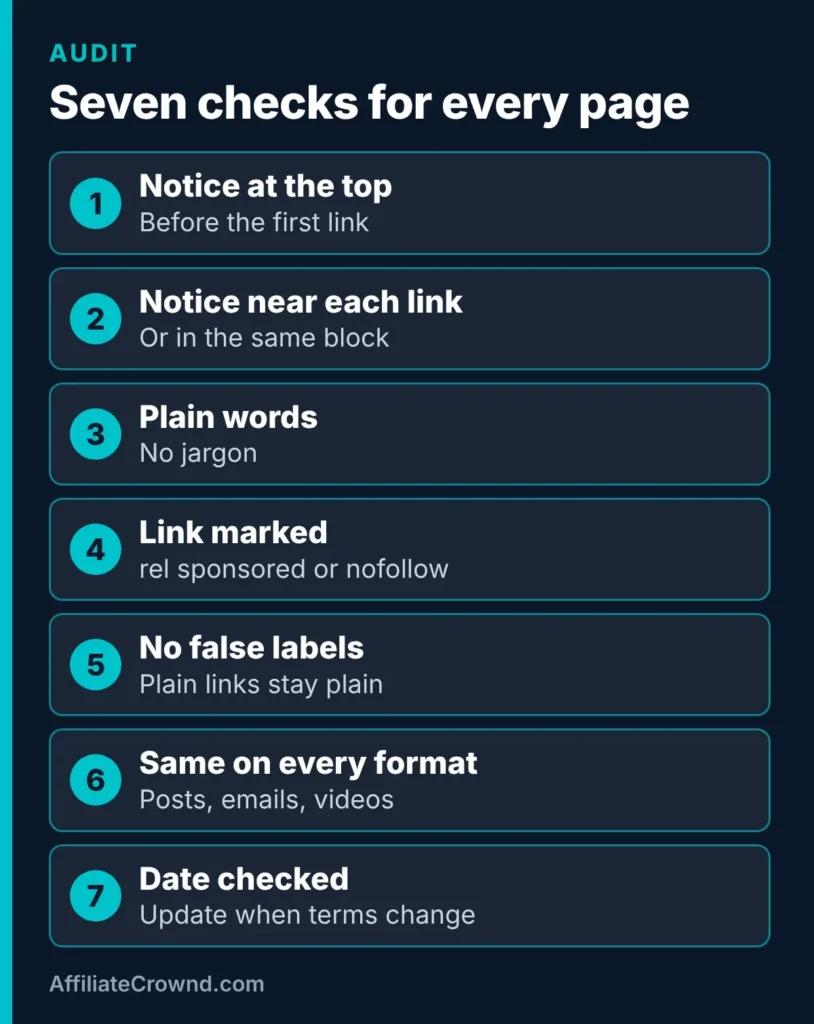
- Is there a plain-words notice at the top, before the first affiliate link?
- Is there a short notice near each button or recommendation on a long page?
- Does the wording say you earn a commission, in everyday language?
- Does every affiliate link carry
rel="sponsored"orrel="nofollow"? - Are plain links left plain, with no false labels?
- Do your emails and videos carry the same disclosure?
- Have you noted the date you last checked the program terms?
A Simple Workflow for Every New Article
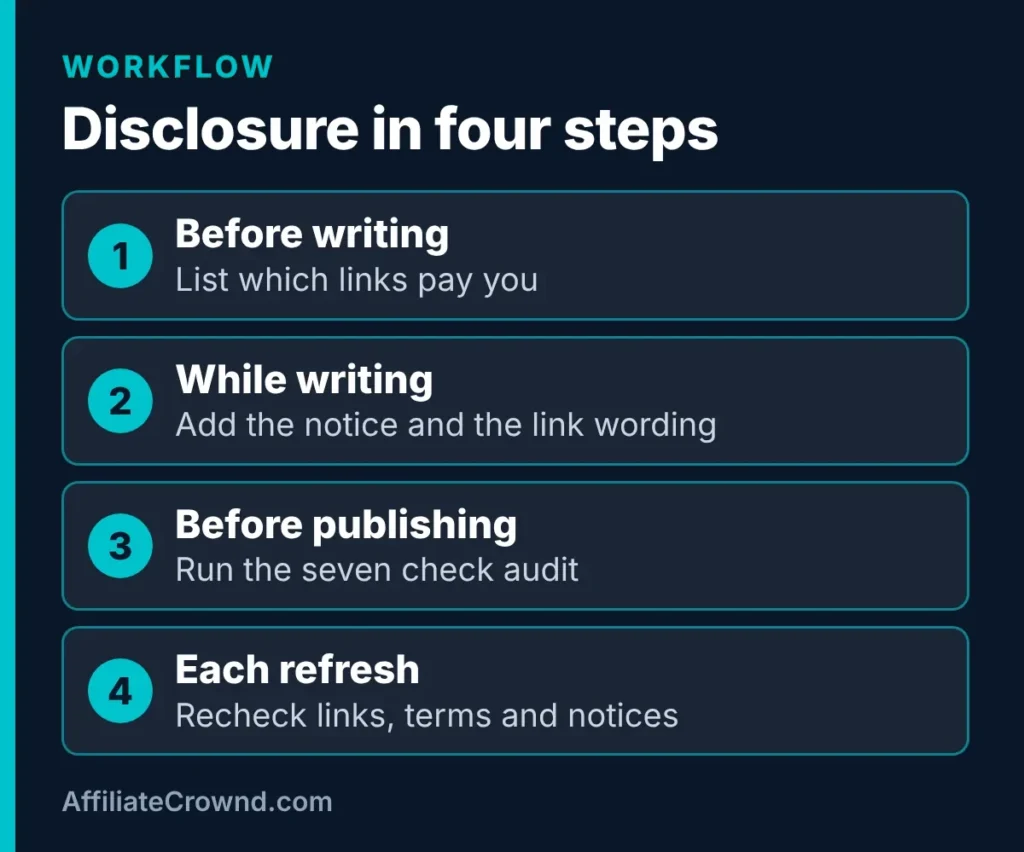
Compliance is easiest when it is part of the routine, not a clean-up job. Before you write, list which links will pay you. While you write, add the notice and put the wording next to each button. Before you publish, run the audit above. At each refresh, recheck the links, the terms and the notices. If you are building your first site, our build an affiliate website on WordPress guide shows where this fits, and Start Here gives the order to follow.
Where to Read the Official Sources
Do not take our word for it. These are the pages we used, and they are short enough to read in one sitting:
- FTC’s Disclosures 101 for Social Media Influencers, a plain-language brochure on what to disclose and where. Last modified December 3, 2024.
- FTC’s Endorsement Guides: What People Are Asking, with a section on affiliate links and reviews. Last modified July 15, 2025.
- Google’s guidance on qualifying outbound links, which explains
sponsored,nofollowandugc. - Google’s spam policies, which covers thin affiliate pages and scaled content abuse.
- Our own affiliate disclosure page, which shows the standard we hold ourselves to.
The FTC itself says its staff guidance is not a safe harbor. If your site earns real money, or you are unsure how a rule applies to you, talk to a qualified lawyer in your country. We are publishers, not lawyers.
Our Honest Recommendation
Disclose clearly, near the link, in plain words, on every page. Mark paid links with the right attribute and leave plain links alone. Then make the page genuinely useful, so the disclosure sits on content you would be happy for a reader to check. That approach costs you a few seconds per page and protects the one thing an affiliate site cannot rebuild quickly: reader trust. We do not promise rankings or income from any of it, and nobody should.
Affiliate Link Disclosure: A Short Recap
Before you act on this guide to affiliate link disclosure, write down your goal, your budget and one thing you will test this week, and keep notes so you can improve next time.
For official guidance, read Google’s SEO starter guide and the FTC’s guidance on endorsements and reviews, and check each tool’s official page for current prices and terms before you decide.
Frequently Asked Questions
Do I have to disclose affiliate links?
If you earn a commission when readers buy through your link, the FTC says to disclose that relationship clearly and conspicuously so readers can weigh your recommendation. This guide covers United States rules, so check the rules in your own country, and ask a lawyer if you are unsure.
Where should an affiliate disclosure go?
As close to the recommendation as you can, and visible before the reader clicks. The FTC pages say a notice at the bottom is easy to miss, a single home page notice is not sufficient, and a hyperlinked DISCLOSURE button is easily avoidable.
What words should I use for an affiliate disclosure?
Use plain language, such as the FTC’s example, “I get commissions for purchases made through links in this post.” The FTC says “paid link” next to a link is adequate, while “affiliate link” alone may not be understood and “commissionable link” is probably unclear.
Should affiliate links use nofollow or sponsored?
Google prefers rel=”sponsored” for paid links and says nofollow is still acceptable. You can use both values together, separated by a space. Google does not require any value, but it says you might want to qualify these links.
Do I need a disclosure if I have no affiliate link?
If you earn nothing and have no relationship with the company, you do not need to state that. If a brand gave you a free product or anything else of value, the FTC says to disclose it. Do not label plain links as sponsored.
Sources checked November 10, 2026: the FTC’s Disclosures 101 for Social Media Influencers and Endorsement Guides Q&A pages, and Google Search Central’s pages on qualifying outbound links and spam policies. Rules and guidance change, so confirm on the official pages. This is general information, not legal advice.