
How to Choose an Affiliate Niche: A Practical Scorecard (2026)
By Oscar · 15 min read
Most beginners spend weeks choosing a niche, pick one that sounds profitable, and quit when the first month is quiet. The problem is not a lack of niches. It is that nobody gave them a way to compare ideas honestly. An affiliate niche is a narrow topic where you help a specific kind of reader solve a problem, and recommend products along the way. This guide gives you a six-question scorecard, shows how to check programs and search interest, and ends with a seven-day test so you can decide with evidence before you build a whole site. The facts below come from official pages we read on November 10, 2026.
Disclosure: this guide has no affiliate links. Program terms are listed as published, with plain links to official pages, and are not earnings estimates. Read how we work in How We Research and Review.
Table of Contents
Quick Answer: How Do You Choose an Affiliate Niche?
- Start with a reader problem you can explain well, not with a list of high paying products.
- Score each idea on six points: interest, experience, reader problem, programs, competition and risk.
- Check that programs exist and read their terms before you commit, including whether commissions recur.
- Test for seven days by drafting outlines and one honest article, then score the idea again.
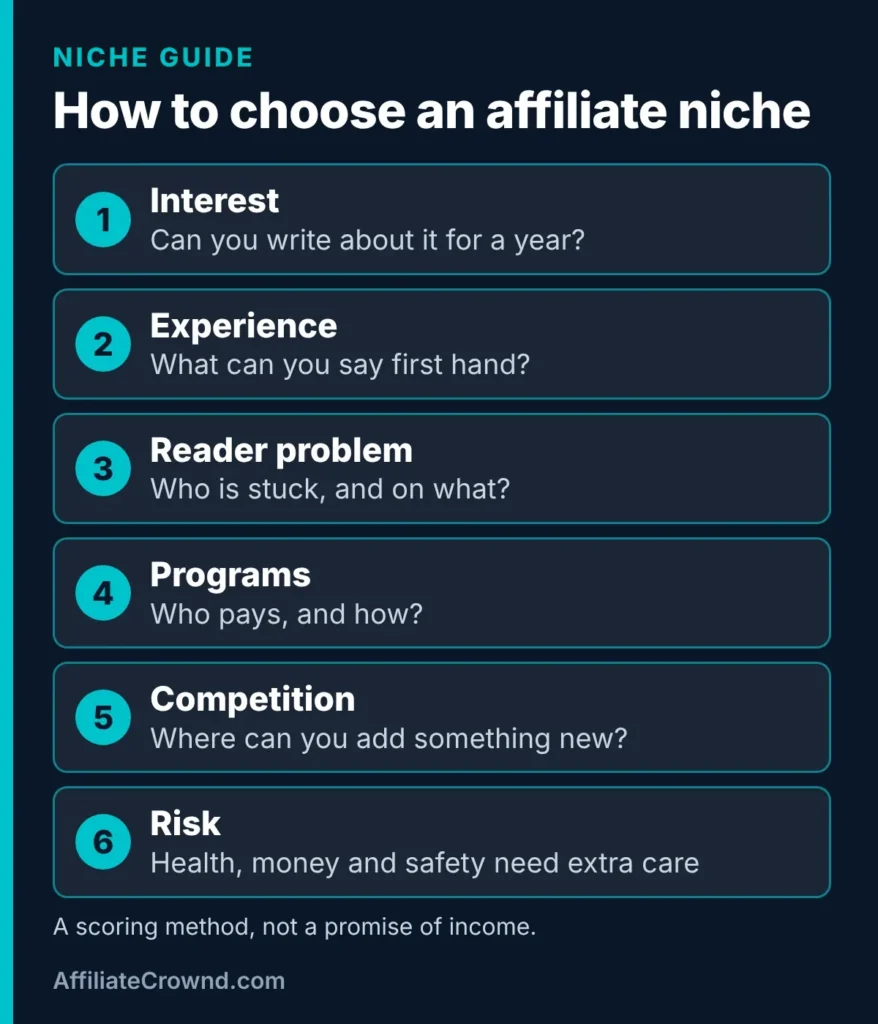
What a Niche Is and Why Narrow Helps
A broad topic such as “technology” has no clear reader. A niche narrows it to someone with a job to do: a first-time blogger choosing hosting, a small seller comparing email tools, a creator adding voiceover to videos. Narrow topics make three things easier. You can write with real detail, you can link your articles together so each one supports the others, and you can recommend products that fit one type of reader instead of everyone.
Narrow does not mean tiny. You want enough questions to fill dozens of articles, and a reader who might need more than one product over time. If you can list ten distinct questions your reader would type into Google, the niche has room. If you struggle to list five, it may be too small.
Start With the Reader, Not the Commission
Google’s own advice is direct about this. In Google’s guidance on helpful, people-first content, the “why” question is described as the most important: content should mainly serve people who would find it useful if they visited the site directly, not mainly attract search engine traffic. The same page lists warning signs of search-engine-first content, including entering niche areas without real expertise mainly for search traffic, and writing about trending topics you would not otherwise cover for your audience.
That matters for niche choice. If you pick a topic only because a program pays well, you will struggle to write anything a reader could not find elsewhere. If you pick a topic where you can say something specific, the commission becomes a by-product of being useful.
The Six-Question Niche Scorecard
Here is the method we recommend. It is our own framework, built from the guidance above and from the checks we run before writing a review. Score each idea from 1 to 5 on the six questions, then add them up. The score does not predict income. It helps you compare ideas on the same terms.
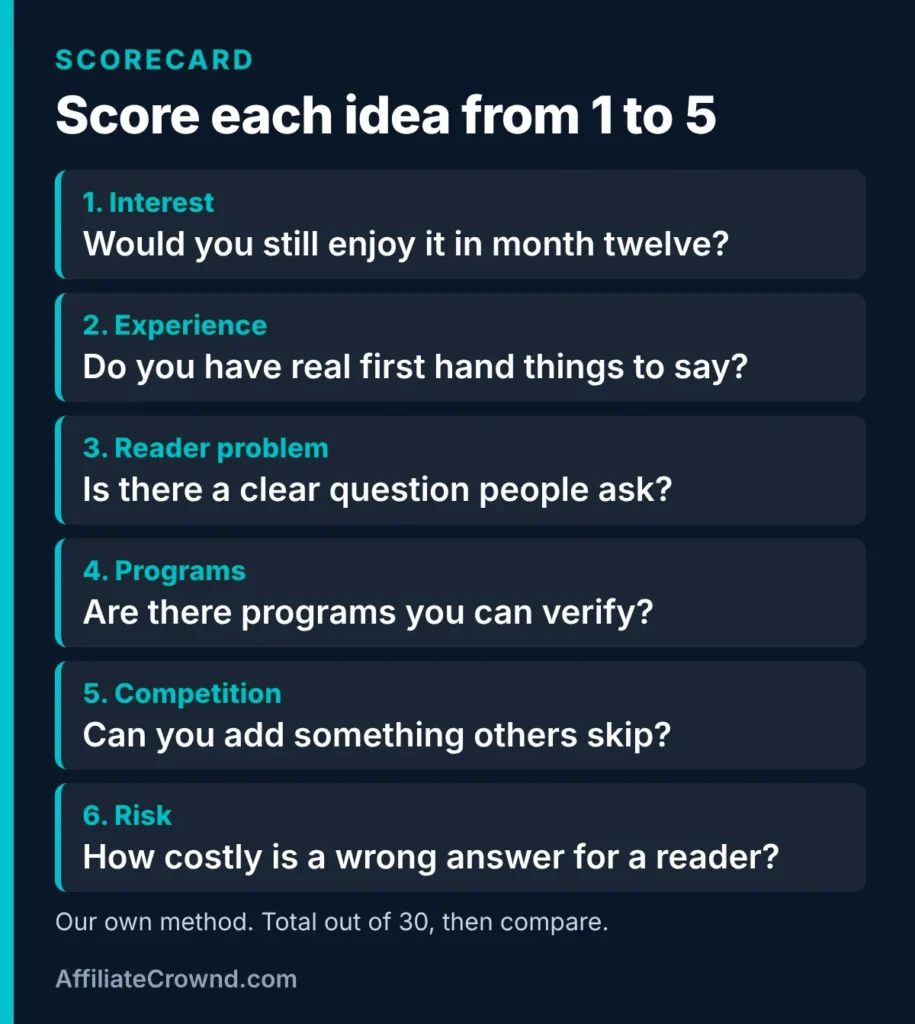
| Question | What to ask yourself | A score of 5 looks like | A score of 1 looks like |
|---|---|---|---|
| 1. Interest | Would I still enjoy this in a year? | I read about it for fun | I only like the idea of the money |
| 2. Experience | What can I say first hand? | I have used the tools or lived the problem | I would be summarizing other sites |
| 3. Reader problem | What question does a reader type into Google? | I can list ten clear questions | I cannot name a specific reader |
| 4. Programs | Who pays, and on what terms? | Several programs I can verify, some recurring | No programs, or terms I cannot find |
| 5. Competition | What can I add that page one lacks? | Original comparisons, tests or checklists | Page one is already complete and I have nothing new |
| 6. Risk | What happens if a reader trusts a wrong answer? | Low cost of error, like picking a tool | High cost of error, like health or money advice |
Question 1: Interest
Publishing is slow. Most sites need months of steady work before results show, and nobody can promise a date. Interest is what keeps you writing through the quiet months. Ask whether you would read this topic on your own time. If not, score low even if the market looks attractive.
Question 2: Experience
Google asks whether content shows first-hand expertise, such as having used a product or visited a place, and whether it is written or reviewed by someone who knows the topic. Experience is also the easiest way to stand apart from pages that only summarize others. Be honest: if you have not used a product, say so, and focus on what you can verify from official pages, as we do. Never invent a test you did not run.
Question 3: Reader problem
Write down who the reader is and what they are stuck on. “Beginners who want to start a blog and do not know which host to choose” is a reader problem. “People who like gadgets” is not. A clear problem gives you article ideas, a natural order for a content series and an obvious moment when a recommendation helps.
Question 4: Programs
Before you commit, confirm that programs exist and read their terms. The terms vary a lot, and that changes how a niche can work. In November 2026 these were published on official program pages, and the differences are the point:
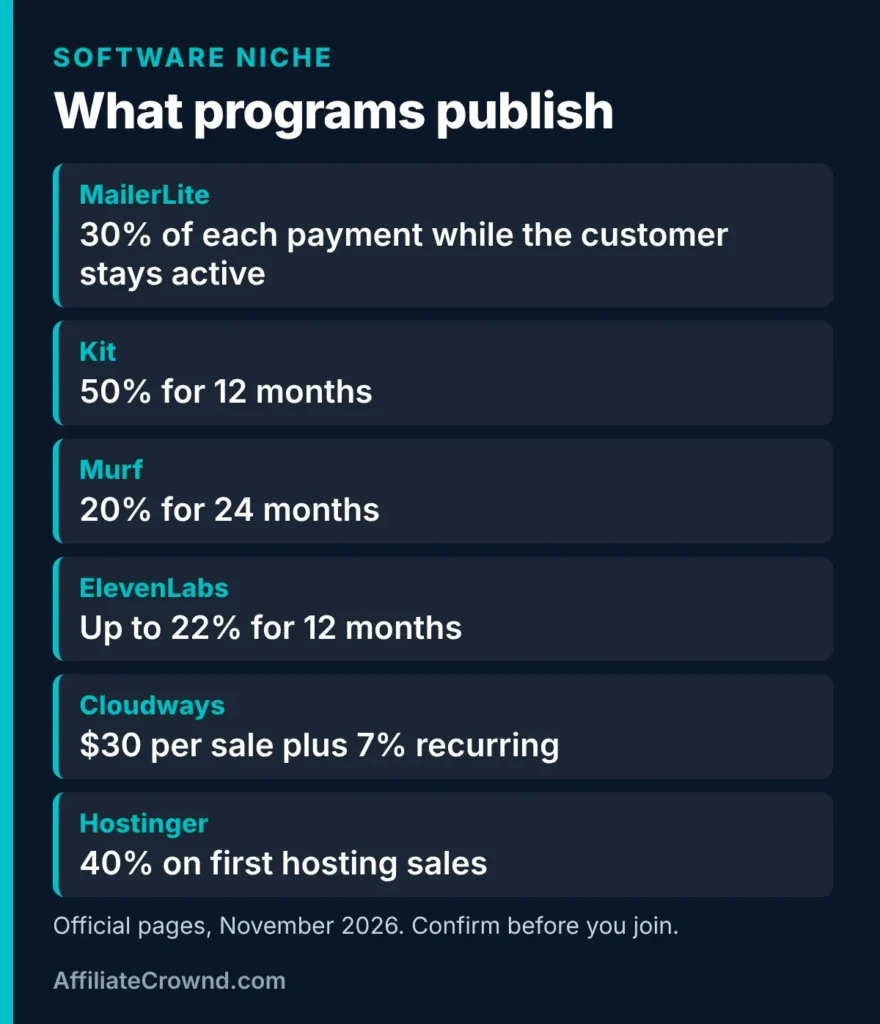
| Program | What its official page says | Type |
|---|---|---|
| MailerLite | 30% of each payment for as long as the customer stays active, 45-day window | Recurring |
| Kit | 50% for 12 months | Recurring, time limited |
| Murf | 20% for 24 months, 90-day window, through PartnerStack | Recurring, time limited |
| ElevenLabs | Up to 22% for 12 months, through PartnerStack | Recurring, time limited |
| Cloudways | Hybrid: $30 per sale plus 7% recurring | Mixed |
| SiteGround | €40 to €75 per sale, by monthly volume | Per sale |
| Hostinger | 40% on first-time hosting sales | First sales |
| ShortPixel | 50% of the acquisition, one-month cookie | Not stated whether recurring |
| Imagify | 20%, one-time and recurring up to 12 months, through Awin | Mixed |
Terms change, so treat this as an example of what to look for, not a list to join blindly. Recurring commissions can add up when readers stay subscribed, but they depend on the customer staying, and the rules differ per program. Per-sale programs pay once. Either can work, but you should know which you are building on. For more detail, read our guide to the best affiliate programs for beginners, and see the best AI voice generators article for voice tool programs.
Also read the restrictions. Some programs limit paid ads or discount codes, so check each program’s terms.
Question 5: Competition
Competition is not a reason to quit. It is a reason to be specific. Search your main questions and read page one. Ask what is missing: a clear comparison table, a plain-words glossary, a checklist, a cost example, a list of what the writer did not test. If page one already covers everything and you cannot add anything, score low. If you can see a clear gap you can fill honestly, score high.
Question 6: Risk
Google says content on topics that affect health, financial stability, safety or societal welfare gets more weight for strong expertise and trust, and should be highly accurate and consistent with expert consensus. That does not mean you cannot write there. It means a wrong answer costs a reader more, and the bar for evidence is higher. If you do not have real expertise and a way to have content reviewed, score risk low and think hard before choosing that niche.
Three Kinds of Niche Compared
Most beginner sites fall into a few families. This comparison is our judgment from published program terms and Google’s guidance. It is not a ranking, and every family has good and bad niches inside it.
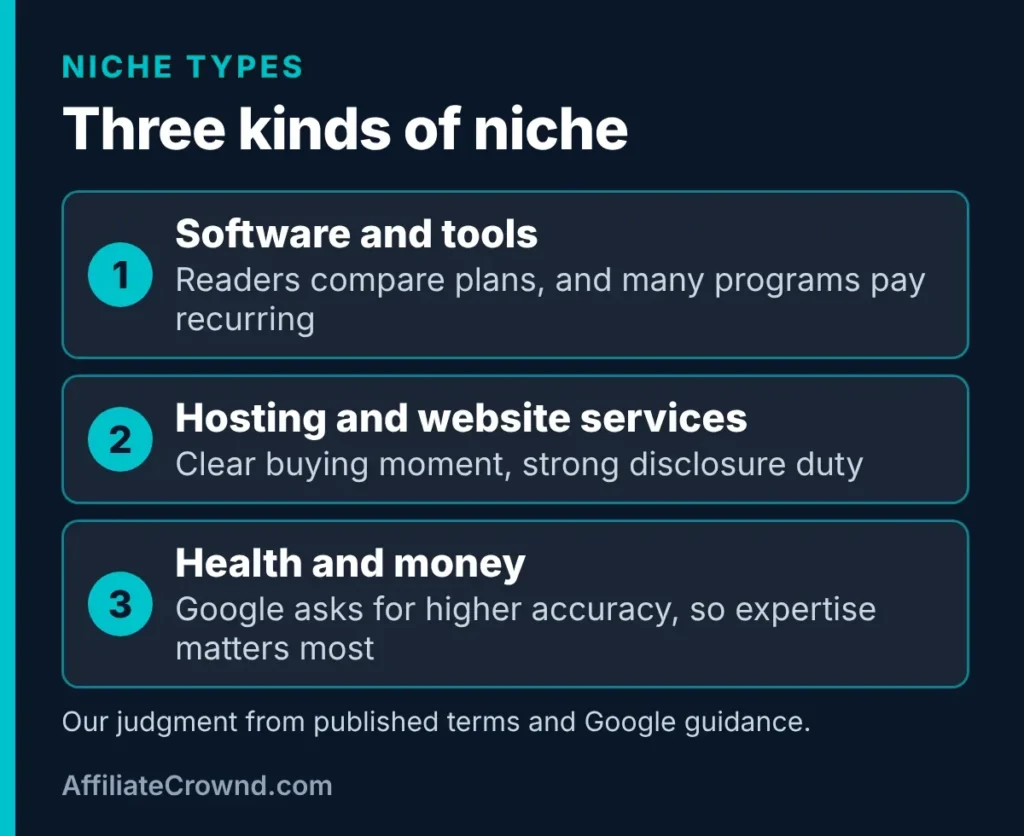
| Niche family | Why it can suit beginners | What to watch |
|---|---|---|
| Software and tools (email, AI, funnels, design) | Readers compare plans, you can verify prices on official pages, and many programs publish recurring terms | Prices and features change often, so articles need regular rechecks |
| Hosting and website services | Readers have a clear buying moment, and programs publish per-sale or hybrid terms | Strong disclosure duty, and you must not claim speed or uptime you have not measured |
| Health, money and safety | Large reader need | Google asks for higher accuracy and expertise, and mistakes cost readers more |
On this site we write about tools for people building affiliate sites: hosting, email, AI voice, image optimization and affiliate programs. We chose to compare official plans and terms and to say plainly what we have not tested. That is one example of a narrow reader, one problem and a clear way to add value, not a guarantee that the same approach will work for you.
Using Google Trends Without Fooling Yourself
Google Trends can help you compare ideas, but it is easy to misread. Based on Google News Initiative lesson on understanding Google Trends data, it analyzes a sample of searches, and the numbers are relative, not absolute. Values are scaled so the peak point in your chart is 100. A value of 50 means half the peak, not 50 searches. A falling line means the term’s share of searches is shrinking, even if total searches are stable or rising. Very small terms can show as zero.
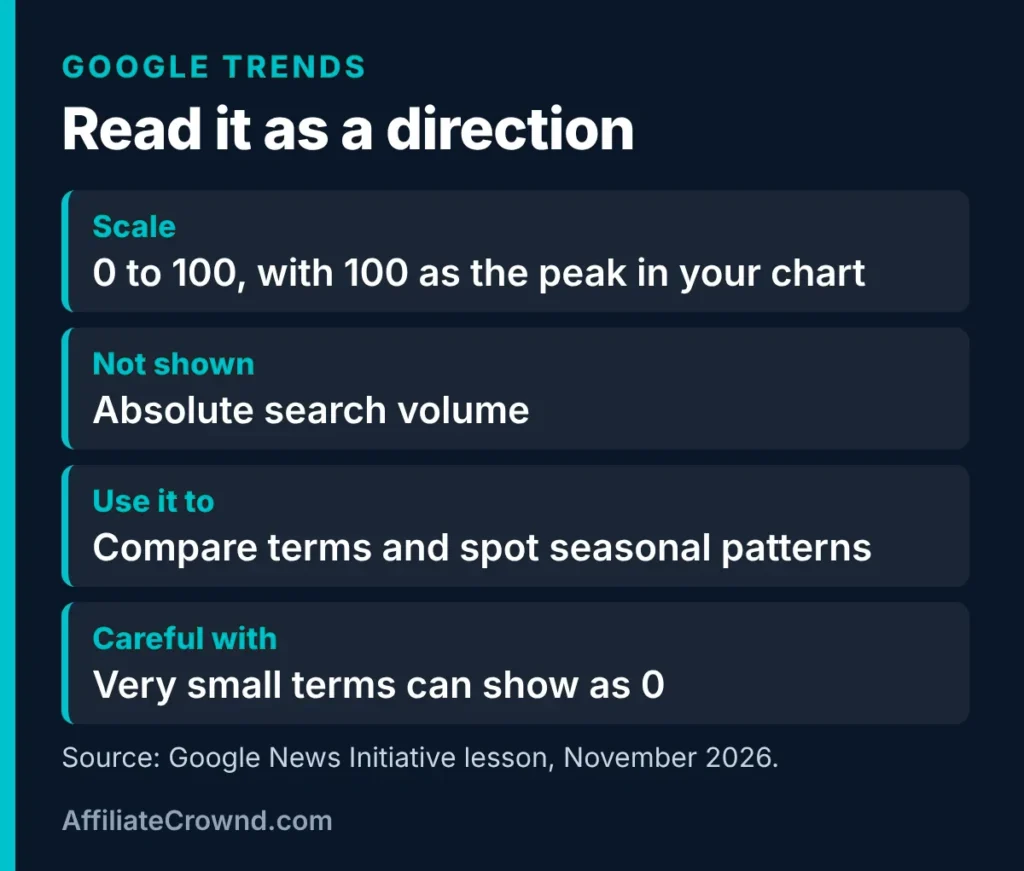
- Compare two or three terms in the same chart to see which one has more relative interest.
- Look at several years to spot seasonal patterns, such as interest that rises every autumn.
- Be careful with sudden spikes. Google warns against covering trending topics you would not otherwise cover for your audience.
- Do not treat it as search volume. It cannot tell you how many people search a term.
Use Trends as one input next to the scorecard, not as a verdict. A topic with steady interest and a clear reader problem is usually a safer base than a topic that spiked once.
Three Affiliate Niche Ideas Scored Step by Step
A scorecard only helps if you can see it used. Below are three made-up beginners, each with one affiliate niche idea. The people are examples, not case studies, and the scores are our judgment using the six questions above. Nothing here is an earnings estimate. The point is to show how the same method can say “go,” “narrow it” or “drop it.”
Example 1: Email tools for small online shops
Maria runs a small handmade jewelry shop and has already set up two email platforms for her own store. She wants to help other small sellers pick an email tool. Interest scores a 4, because she enjoys the topic. Experience scores a 5, because she has used the tools herself and can show real screenshots. The reader problem is clear (a small seller who does not know which tool to start with), so that is a 5.
Several email platforms publish affiliate programs, so programs score a 4 once she reads each set of terms. Competition is real, which makes it a 3, but her angle as a shop owner is specific. Risk is low, a 5. Her total is 26 out of 30, a strong fit. Her next step is the seven-day test below.
Example 2: “Make money online”
James likes the idea of a site about making money online because he has seen programs that pay well. He has not earned money online yet, so experience is a 1. Interest is a 3. The reader problem is vague, a 2, because “people who want money” is not one reader with one job.
Programs exist, a 4. Competition on page one is heavy and repetitive, a 2. Risk is high, a 1, because money topics are the kind Google says need strong expertise and accuracy. His total is 13. Our advice is to drop this version or narrow it hard, for example to “free tools for new bloggers,” where he can test things himself and write honestly.
Example 3: Home coffee equipment
Priya is a coffee fan who owns three grinders and has opinions about all of them. Interest is a 5 and experience is a 4. The reader problem, “which grinder for a beginner’s first espresso setup,” is clear, so a 4.
Programs for physical products often pay lower rates and have short tracking windows, so she scores programs a 3 after checking the terms. Competition is a 3. Risk is low, a 5. Her total is 24, right at the top band. Her best move is to narrow further, for example to budget espresso setups, so her first ten articles serve one reader really well.
| Idea | Total (out of 30) | Our suggestion |
|---|---|---|
| Email tools for small shops | 26 | Strong fit: run the seven-day test |
| “Make money online” | 13 | Drop it or narrow it hard |
| Home coffee equipment | 24 | Good fit: narrow to one reader first |
Notice what decided each result. It was rarely the programs. The ideas that scored well had a reader the writer could picture and experience the writer could show. That is the heart of how to choose an affiliate niche: pick the topic where your own knowledge makes the page better than what already ranks, then check that the business side works. Score your own ideas the same way, write the numbers down, and compare them side by side before you spend money on hosting or tools.
Common Niche Mistakes
- Choosing by commission size alone. A high percentage on a product nobody searches for earns nothing.
- Choosing something too broad. “Technology” has no reader, so every article feels generic.
- Choosing something you will not sustain. Publishing takes months, and interest runs out.
- Entering a high-risk topic without expertise. Google lists this as a warning sign.
- Building the whole site before testing. Write one honest article first.
- Ignoring program terms. Read the cookie window, payout rules and restrictions before you plan around a program.
- Switching niches every month. Authority builds when articles support each other.
A Seven-Day Niche Test
Before you buy hosting or build anything, run this short test. It costs time, not money.
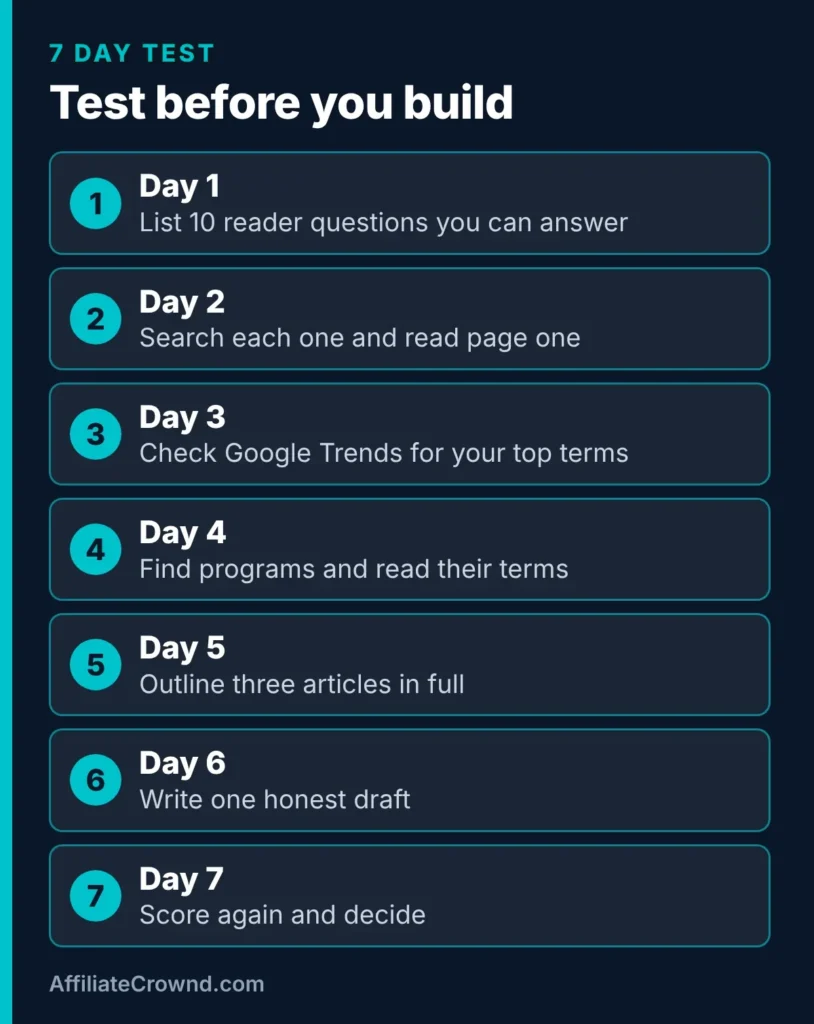
- Day 1: write ten questions a reader in this niche would type into Google.
- Day 2: search each one and read page one. Note what is missing.
- Day 3: compare your top terms in Google Trends and note the direction.
- Day 4: find programs for the products you would recommend, and read their terms, including restrictions.
- Day 5: outline three full articles, with the sections that would make each one more useful than page one.
- Day 6: write one honest draft, with a clear note of what you did not test.
- Day 7: score the idea again. If your score went up, you have evidence. If it fell, you saved weeks.
What to Do With Your Score
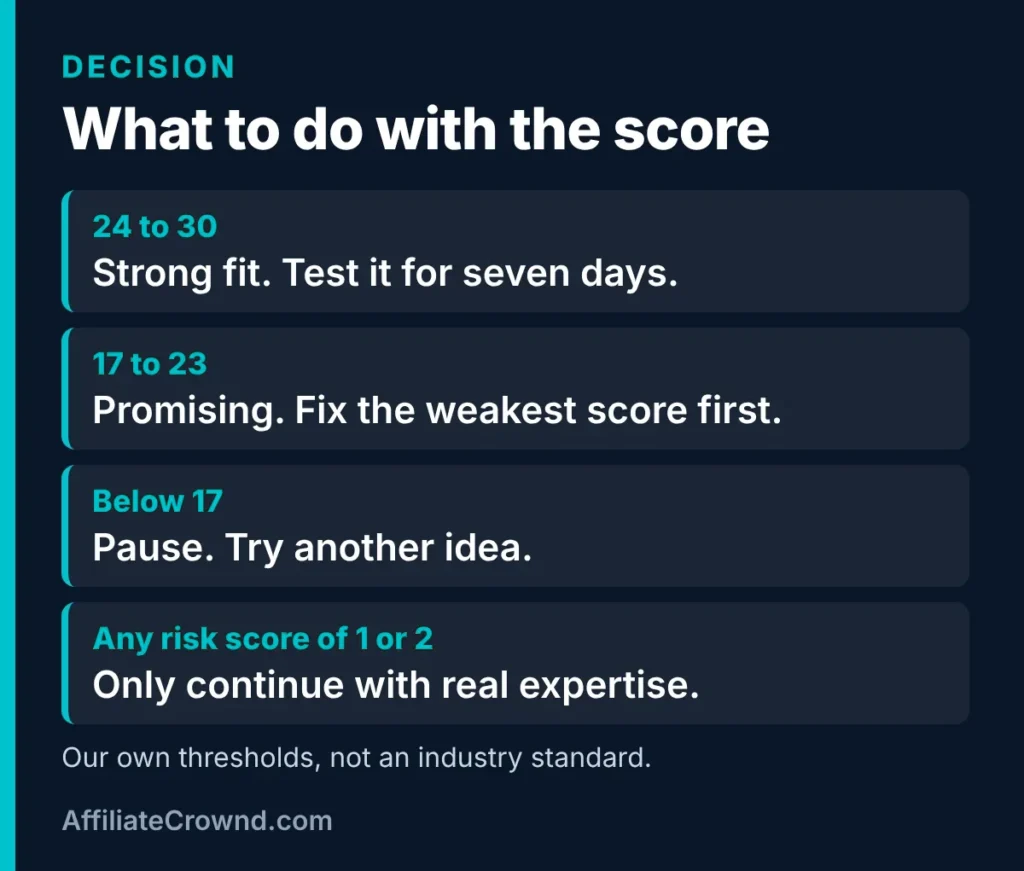
| Total score (out of 30) | What we suggest |
|---|---|
| 24 to 30 | A strong fit. Run the seven-day test. |
| 17 to 23 | Promising. Improve the lowest score first, for example by finding programs or a clearer reader problem. |
| Below 17 | Pause. Try another idea or narrow this one. |
| A risk score of 1 or 2 | Continue only if you have real expertise and a way to have content checked. |
These cut-offs are our own rule of thumb, not an industry standard. Use them to start a conversation with yourself, not to end it.
After You Choose: Where to Go Next
- Check which programs fit your readers in our best affiliate programs for beginners guide.
- Set up your site step by step with our build an affiliate website on WordPress guide.
- Use Start Here for the order we suggest, and our Best Tools page for the tools we cover.
Where to Look for Programs and Data
You will usually find programs in three places: the brand’s own affiliate page, an affiliate network, or a partner platform. In this guide, ElevenLabs and Murf appear through PartnerStack and Imagify through Awin, as listed on their official pages. Always apply through the official page, read the terms and keep a note of the date. For search interest, Google Trends is free to use, and the lesson linked above explains how to read it.
Our Honest Recommendation
Choose the niche where you can explain a real problem better than the pages already ranking, where programs exist that you have actually verified, and where a wrong answer will not hurt a reader. Test it for seven days before you commit. Do not choose by commission alone, and do not choose something you will not still enjoy next autumn. We cannot promise rankings, income or a timeline for any niche, and neither should anyone selling you a list of “best” niches.
How To Choose An Affiliate Niche: A Short Recap
Before you act on this guide to how to choose an affiliate niche, write down your goal, your budget and one thing you will test this week, and keep notes so you can improve next time.
For official guidance, read Google’s SEO starter guide and the FTC’s guidance on endorsements and reviews, and check each tool’s official page for current prices and terms before you decide.
Frequently Asked Questions
How do I choose an affiliate niche as a beginner?
Start with a reader problem you can explain well, then score each idea on interest, experience, reader problem, programs, competition and risk. Check that programs exist and read their terms, then run a short test before building a whole site.
Does a niche need to be profitable to start?
You should check that programs exist and that readers have a clear buying decision, but nobody can promise income from a niche. Treat profit as something you test, not something you assume.
Can I choose a health or money niche?
You can, but Google says topics affecting health, financial stability, safety or societal welfare get more weight for strong expertise and trust, and should be highly accurate and consistent with expert consensus. Without real expertise and a review process, it is usually wiser to start elsewhere.
How do I read Google Trends for niche research?
Google Trends shows relative interest from 0 to 100, where 100 is the peak in your chart. It does not show absolute search volume, so use it to compare terms and spot patterns, not to count searches.
Should I pick a niche with recurring commissions?
Recurring commissions can help, but they depend on the customer staying and the program rules differ. Compare what each program publishes, for example whether it pays for a limited number of months or while the customer stays active, and choose based on your readers as well as the payout.
Sources checked November 10, 2026: Google Search Central’s guidance on creating helpful, people-first content; the Google News Initiative lesson on understanding Google Trends data; and the official affiliate program pages for MailerLite, Kit, Murf, ElevenLabs, Cloudways, SiteGround, Hostinger, ShortPixel and Imagify as read for our program articles. Terms change, so confirm on each official page.